Emmanuel Macron Biography: Age, Height, Wife, Career, Net Worth & Presidency
Comprehensive biography of Emmanuel Macron, President of the French Republic: verified height, age, early life, career from Rothschild banking to Élysée Palace, marriage to Brigitte, and net worth reality.
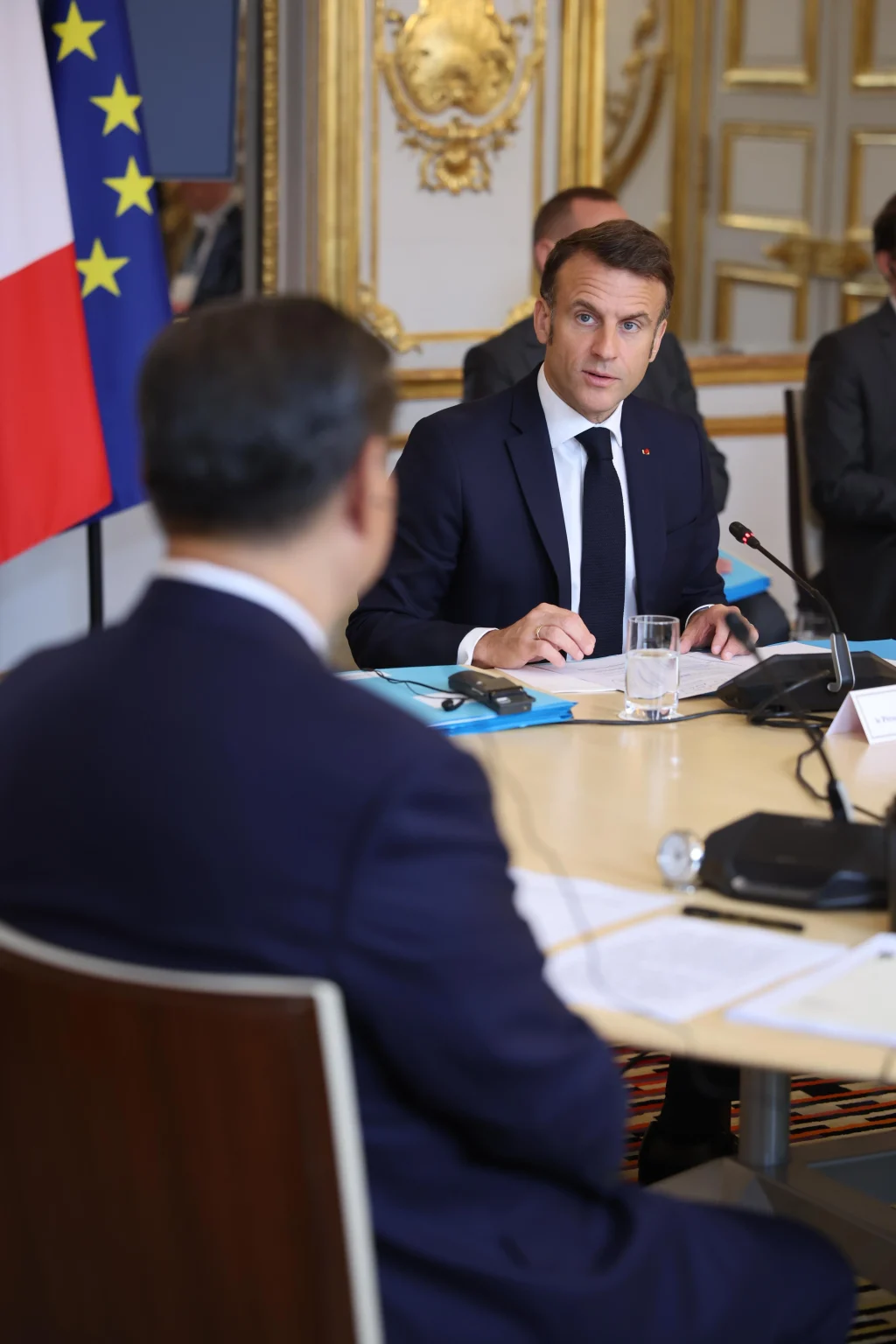
Photo: Christophe Licoppe / European Union
He didn’t rise through the usual party machinery. In May 2017, at 39 years old, Emmanuel Macron walked into the Élysée Palace as France’s youngest head of state since Napoleon Bonaparte. The victory shocked Europe. In a single election cycle, his newly minted movement obliterated the traditional Gaullist conservatives and Socialists who had shared power in Paris for more than half a century.
Winning a second mandate in April 2022 against Marine Le Pen made him the first French president in twenty years to secure re-election without being hamstrung by a hostile prime minister in a cohabitation. But governing has rarely been quiet. His two terms have been defined by stubborn street resistance, from yellow vests blocking roundabouts to nationwide strikes over retirement ages, followed by fractured legislative assemblies that forced French politics into uncharted territory.
| Full Legal Name | Emmanuel Jean-Michel Frédéric Macron |
|---|---|
| Date of Birth | December 21, 1977 |
| Current Age | 48 years old (as of November 2026) |
| Place of Birth | Amiens, Somme, France |
| Height | 173 cm (5 ft 8 in) |
| Office | President of the French Republic (Inaugurated May 14, 2017) |
| Party / Movement | Renaissance (founded as En Marche ! in April 2016) |
| Spouse | Brigitte Macron (née Trogneux, m. October 20, 2007) |
| Alma Mater | Paris Nanterre University (Philosophy), Sciences Po, École Nationale d’Administration (ENA, Promotion 2004) |
| Public Financial Declarations | Declared to HATVP at roughly €500,000 to €800,000 in liquid banking assets and royalties; speculative billionaire claims unverified |
Early Life, Family Heritage, and Academic Path
Amiens was where it started. Macron’s parents were both medical doctors: his father, Jean-Michel Macron, taught neurology at the local university hospital, and his mother, Françoise Noguès, worked as a physician in social security administration. But the person who pushed his intellect hardest was his grandmother Germaine Noguès, known as “Manette,” a retired school director who spent afternoons drilling him on Molière, Racine, and French grammar.
He played classical piano for ten years at the Amiens conservatory. At the Jesuit-run Lycée La Providence, he threw himself into school plays. For his final year, his family sent him south to Paris to attend the formidable Lycée Henri-IV, where he completed his baccalauréat and prepared for university entrance competitions.
Macron didn’t jump immediately into law or politics. He studied philosophy at Paris Nanterre University, writing an advanced dissertation examining Machiavelli and Hegel, while earning cash helping philosopher Paul Ricœur index his major philosophical volume Memory, History, Forgetting. He followed that with a master’s in public affairs at Sciences Po, before earning a spot at the École Nationale d’Administration (ENA) in Strasbourg. When he finished in 2004 in the Léopold Sédar Senghor cohort, he earned a coveted slot inside the General Inspectorate of Finance.
Civil Service, Investment Banking, and the Call from Hollande
Macron spent four years auditing state spending from inside the Ministry of Economy. By 2007, his knack for numbers caught the attention of Jacques Attali, who tapped the young auditor as deputy rapporteur for a blue-ribbon commission tasked with reviving the country’s stagnant economic growth.
Then he took an unconventional detour. In 2008, he walked away from civil service tenure to join Rothschild & Cie Banque as an investment banker. It didn’t take long for him to close big files. In 2012, he orchestrated Nestlé’s $11.9 billion buyout of Pfizer’s infant formula unit, beating out rival bids and securing a payout that made him financially comfortable before his thirty-fifth birthday.
Private equity didn’t keep him. In May 2012, newly elected Socialist President François Hollande recruited Macron as his deputy chief of staff at the Élysée. Two years later, Hollande reshuffled his cabinet and handed Macron the Ministry of Economy, Industry and Digital Affairs. As minister, Macron pushed through the controversial Loi Macron, deregulating intercity buses—soon dubbed “Macron coaches”—and expanding Sunday retail trade. Left-wing party stalwarts grumbled loudly, viewing him as an uninvited free-marketeer. By August 2016, Macron decided he had outgrown Hollande’s administration and walked out.
Building En Marche and Navigating the Presidency
Four months before leaving cabinet, Macron had already launched En Marche ! from Amiens. His proposition was straightforward: discard the exhausted left-right dichotomy, unleash business innovation, and strengthen France’s weight inside the European Union. His campaign caught lightning. When mainstream conservative and Socialist candidates stumbled over ethical investigations and factional infighting in early 2017, Macron vaulted past them, taking 66.1% of the runoff vote against Marine Le Pen.
His early presidency moved fast. He overhauled rigid French labor laws, scrapped the long-standing wealth tax on movable assets, and introduced flat capital taxes. Unemployment fell, but working-class frustration simmered. In late 2018, an planned fuel duty increase ignited the yellow vest movement. Week after week, demonstrators occupied roundabouts, brought Paris boulevards to a standstill, and vandalized monuments. Macron conceded: he paused the taxes, launched three months of public town-hall meetings, and signed off on €10 billion in emergency household relief.
Macron’s re-election in 2022 was tighter, finishing at 58.5%. His second term quickly plunged into bruising parliamentary brawls. In 2023, his government pushed through legislation raising the baseline retirement age from 62 to 64, relying on constitutional mechanism 49.3 to bypass a direct parliamentary vote, sparking angry street demonstrations and garbage collector strikes across major cities.
On foreign policy, Macron has consistently championed European strategic sovereignty, arguing that Europe cannot remain dependent on external security guarantees. That assertive, often contentious diplomatic cadence brings to mind the multilateral debates dissected by figures like Shashi Tharoor, whose career has centered on global diplomacy and statecraft. Meanwhile, Macron’s balancing act between fiscal austerity and major public infrastructure spending reflects structural battles similar to those navigated in fast-growing global economies by ministers like Nirmala Sitharaman and Hardeep Singh Puri.
Personal Life, Brigitte, and Wealth Disclosures
Few aspects of Macron’s public identity have generated as much ink as his marriage. He met Brigitte Trogneux in 1993 at Lycée La Providence in Amiens. He was a 15-year-old student; she was a 39-year-old married mother of three running the school drama group. Despite intense parental pushback and local gossip, the relationship persisted after Macron moved to Paris. They married in October 2007 in Le Touquet, where the family keeps a holiday home.
The couple has no children together. Macron has instead integrated into Brigitte’s extended family, which includes her three adult children—Sébastien, Laurence, and Tiphaine—and seven grandchildren. In August 2017, the Élysée issued a formal transparency charter specifying that Brigitte receives no personal state salary, using an assigned staff to handle charitable initiatives focused on hospital support, disability rights, and anti-bullying programs.
Online celebrity trackers routinely fabricate sensational figures about his private wealth, claiming multi-million-euro secret holdings. French disclosure laws don’t leave much room for guesswork. Under statutory declarations reviewed by the High Authority for Transparency in Public Life (HATVP), Macron declared between €500,000 and €800,000 in liquid banking accounts, mutual funds, life insurance, and residual royalties from his 2016 campaign book Révolution. He owns no real estate in his own name. The Villa Monéjan in Le Touquet belongs to Brigitte Macron, having been inherited from her family.
Emmanuel Macron Social Media Presence & Verified Accounts
Emmanuel Macron uses verified social accounts to broadcast official statements, state visit updates, and domestic policy announcements directly to the public:
| Platform | Verified Handle / Profile | Direct Link |
|---|---|---|
| X (formerly Twitter) | @EmmanuelMacron | Visit X Profile |
| @emmanuelmacron | Visit Instagram | |
| Emmanuel Macron Official | Visit Facebook Page | |
| YouTube | @emmanuelmacron | Visit YouTube Channel |
| Official Presidential Portal | Élysée Palace | Visit Élysée Palace |
Frequently Asked Questions About Emmanuel Macron
Question: How tall is Emmanuel Macron?
Answer: Emmanuel Macron stands 173 cm tall, which converts to approximately 5 feet 8 inches. While some French administrative forms and diplomatic records have cited 1.77 m, independent media comparisons consistently place his standing height at 1.73 m.
Question: What is Emmanuel Macron’s age in 2026?
Answer: Born on December 21, 1977, Emmanuel Macron is 48 years old as of November 2026. He marks his 49th birthday in late December 2026.
Question: Where did Emmanuel Macron study?
Answer: Macron studied philosophy at Paris Nanterre University, completed a public affairs master’s degree at Sciences Po Paris, and graduated in 2004 from the École Nationale d’Administration (ENA).
Question: Who is Emmanuel Macron married to?
Answer: He is married to Brigitte Macron (formerly Brigitte Trogneux). They first met in Amiens at a high school theatre workshop and married on October 20, 2007, in Le Touquet.
Question: What is Emmanuel Macron’s verified net worth?
Answer: Official filings submitted to France’s High Authority for Transparency in Public Life (HATVP) show approximately €500,000 to €800,000 in liquid banking accounts, investment funds, and book royalties. Speculative tabloid rumors claiming billionaire status are unfounded.
Question: When did Emmanuel Macron become President of France?
Answer: Macron won the French presidential election on May 7, 2017, taking office on May 14 at age 39. He won a second five-year term on April 24, 2022.