Swami Ramdev: Biography, Age, Height, Early Life, Patanjali Enterprise & Spiritual Impact
Comprehensive biography of Swami Ramdev (Baba Ramdev): from rural Haryana roots and gurukul training to building Patanjali Ayurved, yoga revolution, Supreme Court case, and verified accounts.
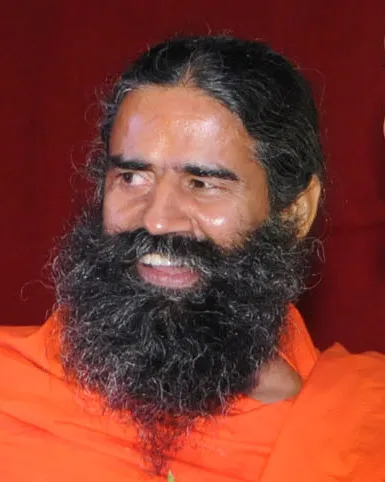
Photo: Ministry of Home Affairs / Government of India
Walk through an Indian train station or suburban bus depot at six in the morning, and the rhythmic sound of forced exhalations drifting out of small transistor radios and living room TVs is instantly recognizable. For over two decades, that rapid, percussive breathwork has had a single recognizable face: Swami Ramdev. Draped in unstitched saffron cotton and perched on wooden platforms, he turned pranayama into a daily national ritual. Before him, yoga was largely viewed by urban Indians as an esoteric retreat for retirees or Himalayan recluses. He turned it into accessible morning medicine.
Yet Ramdev’s story is never just about yoga mats.
Alongside Acharya Balkrishna, he co-founded Patanjali Ayurved in 2006, expanding a modest Ayurvedic pharmacy in Haridwar into a multi-billion-rupee FMCG enterprise that openly rattled multinational consumer giants. His relentless swadeshi sermons, stadium-sized crowds, and political crusades made him an extraordinary hybrid: part sannyasi, part media titan, and part industrial disruptor.
The climb has not been friction-free. In August 2024, the Supreme Court of India formally closed a bitter contempt case against Ramdev, Balkrishna, and Patanjali Ayurved over misleading medicinal advertisements, but only after demanding unconditional apologies and prominent front-page newspaper retractions. As of November 2026, at age 60, Ramdev remains an active public figure, still presiding over extensive educational and yogic headquarters in Uttarakhand.
Swami Ramdev Quick Biography Facts
| Full Legal Name | Ram Kisan Yadav (also spelled Ramkishan Yadav) |
|---|---|
| Monastic Honorific | Swami Ramdev (popularly known as Baba Ramdev) |
| Date of Birth | 25 December 1965 (some informal biographical sketches cite 1971) |
| Current Age | 60 years old (as of November 2026) |
| Birthplace | Saied Alipur village, Mahendragarh district, Haryana, India |
| Height | Approx. 5 ft 8 in (173 cm) |
| Parents | Ram Niwas Yadav (father) and Gulabo Devi (mother) |
| Siblings | Devdutt (older brother), Ram Bharat (younger brother), Ritambhara (sister) |
| Education & Gurukuls | Shahbazpur Government School; Arsh Gurukul Mahavidyalaya; Gurukul Kalwa (Sanskrit grammar, Darshana, and Yoga under Acharya Baldevji) |
| Spiritual Mentor (Diksha) | Swami Shankar Dev Ji (Haridwar) |
| Key Institutions Founded | Divya Yog Mandir Trust (1995), Patanjali Yogpeeth (2006), Patanjali Ayurved, Bharat Swabhiman Trust |
| Personal Shareholding | 0% equity in Patanjali Ayurved (94–96% owned by Acharya Balkrishna) |
| Marital Status | Unmarried (lifelong sannyasi vows of renunciation and celibacy) |
Early Roots: Rural Haryana and Overcoming Childhood Paralysis
Saied Alipur is an arid village tucked into southern Haryana’s Mahendragarh district. It was here, on December 25, 1965, that Ram Kisan Yadav was born into an ordinary farming family. His parents, Ram Niwas Yadav and Gulabo Devi, worked demanding seasonal agricultural cycles. Life was plain. Ram Kisan grazed cows, hauled well water, and helped tend mustard crops alongside his brothers Devdutt and Ram Bharat.
Then illness hit.
During early childhood, the left side of his face went partly paralyzed. His left eye was compromised. In rural Haryana during the 1970s, specialized neurological care was impossible to find. Teased by classmates and struggling with basic facial function, Ram Kisan began experimenting with intense bodily stretches, physical calisthenics, and breath control drills. Slowly, muscle tone returned. The recovery left a lasting impression: physical discipline was not just spiritual philosophy—it was practical survival.
He attended a village government school at Shahbazpur through standard eight. Standard textbooks bored him. After coming across Swami Dayananda Saraswati’s reformist tract Satyarth Prakash, he walked away from mainstream schooling altogether. He wanted classical Vedic training.
Gurukul Immersion and Sannyasa Initiation in Haridwar
Between 1984 and 1989, Ramdev studied at Arsh Gurukul Mahavidyalaya after a brief stint in Khanpur. At fourteen, he entered Gurukul Kalwa in Jind district. Daily life under Acharya Baldevji was austere. Pre-dawn cold baths were mandatory. Days were spent chanting Vedic mantras and dissecting Panini’s complex Sanskrit grammar rules (Ashtadhyayi) line by line.
Kalwa produced another life-altering encounter: he met Balkrishna.
The two teenagers hit it off immediately. Ramdev possessed boundless stamina and a natural gift for commanding crowds. Balkrishna was quieter, drawn to old manuscripts, botanical identification, and Ayurvedic pharmacology. On mornings off, they ran free yoga workshops for local villagers in Haryana fields, experimenting with ways to make ancient techniques intuitive.
In 1992, studies behind him, Ramdev headed for Haridwar. At Kripalu Bagh Ashram, he trained under Acharya Karamveer and took formal sannyasa vows under Swami Shankar Dev Ji. He severed worldly ties, cast off his birth surname, donned unstitched saffron robes, and stepped out as Swami Ramdev.
The Television Revolution: Democratizing Yoga Across Millions
In 1995, Ramdev, Balkrishna, and Swami Muktanand founded the Divya Yog Mandir Trust in Kankhal, Haridwar. The early days were a grind. Ramdev hopped on state transport buses with a bedroll, teaching free classes in dusty neighborhood parks. Balkrishna stayed behind in Haridwar grinding herbs to make traditional Chyawanprash.
Then cable TV exploded across India.
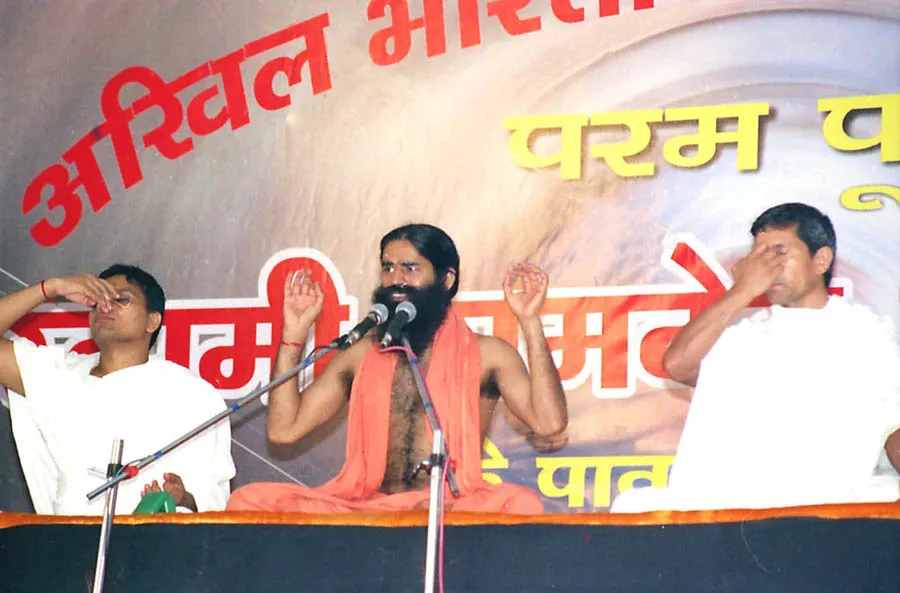
In 2002, Aastha TV and Sanskar TV began broadcasting his morning sessions. The response was electric. Most classical gurus sat motionless, speaking in lofty abstractions. Ramdev bounced on stage in wooden clogs, cracked earthy jokes in plain rustic Hindi, and demonstrated frantic belly contractions at blistering speed. He stripped down complex pranayama into five easy-to-remember drills: Kapalbhati, Anulom Vilom, Bhastrika, Bhramari, and Ujjayi.
Within three years, entire families were rising at 5:00 AM to pump their stomachs in front of TV screens. Stadiums filled up. Sessions in Delhi, Mumbai, and Varanasi drew upwards of 100,000 people at a time. While contemporary yogic teachers like Sadhguru or Sri Sri Ravi Shankar built vast networks among urban professionals and Western spiritual seekers, Ramdev captured India’s lower-middle class—millions dealing with diabetes, blood pressure, and tight household budgets.
Building Patanjali: Swadeshi Commerce and Corporate Scale
Followers attending camps kept asking for pure Ayurvedic medicines. In 2006, Ramdev and Balkrishna founded Patanjali Yogpeeth in Haridwar, constructing a colossal multi-acre campus for treatments and Ayurvedic clinical research. That same year, Patanjali Ayurved Limited was incorporated to manufacture consumer products at industrial scale.
Patanjali’s marketing pitch was aggressive and direct. Ramdev pitched his products not just as herbal alternatives, but as an act of patriotic duty. Buy swadeshi, he urged, and stop sending Indian consumer rupees to foreign multinationals. Shelves soon filled with Dant Kanti toothpaste, cow ghee, mustard oil, washing detergents, and herbal shampoos—all priced below established brands.
By 2016, Patanjali was logging annual revenues in the thousands of crores, forcing legacy competitors like Unilever and Colgate to scramble and launch their own natural product lines. Yet the corporate structure remained peculiar: Ramdev, bound by monastic vows of poverty, holds 0% equity. Balkrishna owns roughly 94% to 96% of the company, while Ramdev’s younger brother, Ram Bharat, stepped in to oversee commercial operations.
Political Crossings and the 2011 Ramlila Maidan Showdown
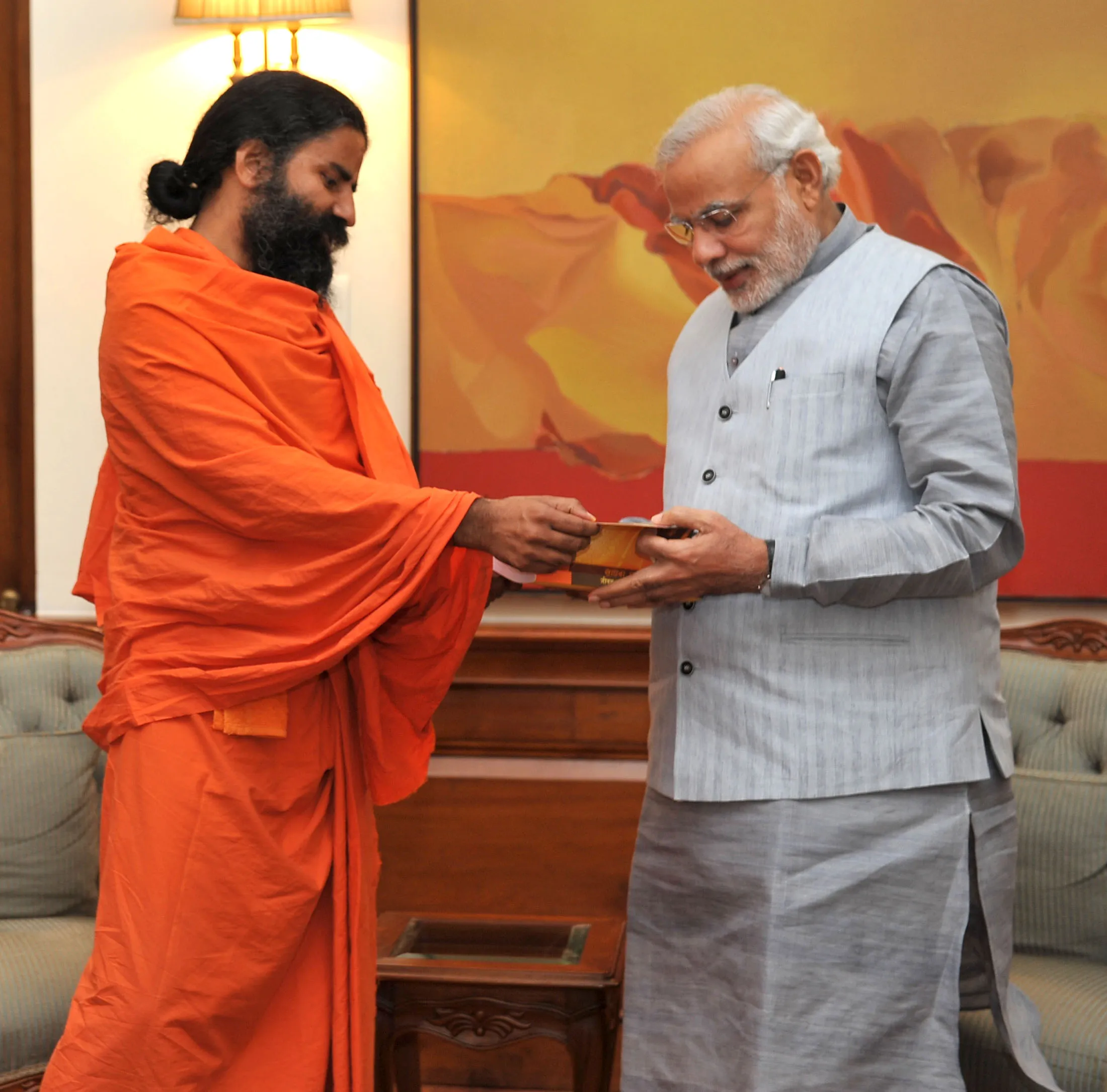
Inevitably, Ramdev’s massive pulpit spilled into politics. In 2010, he launched the Bharat Swabhiman Trust, touring the country to demand severe penalties for financial graft and the immediate repatriation of Indian black money parked in Swiss banks.
In June 2011, he staged an indefinite hunger strike at Delhi’s Ramlila Maidan, drawing 65,000 supporters. Just after midnight on June 4, Delhi Police stormed the grounds with tear gas and batons. During the melee, Ramdev famously slipped into a woman’s salwar kameez in a bid to escape before being intercepted and deported to Uttarakhand. The high-drama midnight raid triggered public fury and poured fuel on the nationwide anti-corruption wave that drastically altered Indian politics in 2014.
Legal Reckonings: The Supreme Court Misleading Advertisements Battle
Ramdev’s freewheeling verbal style has repeatedly landed him in hot water. During the COVID-19 pandemic, Patanjali launched “Coronil,” touting it as a complete cure for the virus before union health regulators forced the company to downgrade its labeling to an herbal immunity booster. Simultaneously, Ramdev publicly derided modern allopathic medicine, prompting the Indian Medical Association (IMA) to file lawsuits accusing him of endangering public health.
The friction culminated in landmark contempt proceedings before the Supreme Court of India. In early 2024, Justices Hima Kohli and Ahsanuddin Amanullah hauled Ramdev, Balkrishna, and Patanjali Ayurved into court for breaching sworn undertakings regarding misleading advertising.
The bench was unsparing. When Patanjali filed preliminary apologies, the judges called them inadequate and ordered both men to appear in person. After stern reprimands, Patanjali took out prominent “Unconditional Public Apology” notices in national and regional newspapers. On August 13, 2024, the Supreme Court officially closed the contempt proceedings, accepting their apologies while warning that any future breach would be met with immediate punitive action.
Demystifying Wealth: Ascetic Reality vs Corporate Billions
Headlines routinely label Ramdev a billionaire guru. Those claims ignore basic corporate filings.
As a sannyasi, Ramdev possesses no personal bank balances, no company equity, and no private real estate. His name appears on no share registries for Patanjali Ayurved. That entire financial valuation rests with Acharya Balkrishna, whose net worth regularly features on global wealth lists. Ramdev draws no executive salary. He lives in simple ashram quarters at Patanjali Yogpeeth, utilizing trust infrastructure for his lectures and tours. While public interest in spiritual teachers like Gaur Gopal Das or modern philosophical speakers like Acharya Prashant often stirs debate over personal assets, Ramdev’s individual net worth remains officially unverified because he legally owns nothing.
Swami Ramdev Social Media Presence & Verified Accounts
Swami Ramdev commands a digital network of tens of millions of followers across verified accounts, streaming daily yoga sessions and health announcements:
| Platform | Handle / Account | Verified Direct Link |
|---|---|---|
| X (formerly Twitter) | @yogrishiramdev | Visit Official Profile |
| @swaamiramdev | Visit Official Profile | |
| Swami Ramdev Official | Visit Official Profile | |
| YouTube | @SwamiRamdevOfficial | Visit Official Channel |
| Patanjali Portal | Official Enterprise Website | Visit Patanjali Ayurved |
Frequently Asked Questions About Swami Ramdev
Question: What is Swami Ramdev’s actual height?
Answer: Swami Ramdev’s height is approximately 5 feet 8 inches (173 cm). Because he is an ascetic monk rather than a competitive athlete, this figure comes from established biographical sources rather than sports registries.
Question: How old is Swami Ramdev, and what is his birth date?
Answer: Swami Ramdev is 60 years old as of November 2026. Official government records and Wikidata document his birth date as December 25, 1965, though some informal accounts mention 1971.
Question: What was Swami Ramdev’s name before renunciation?
Answer: His birth name was Ram Kisan Yadav (also spelled Ramkishan Yadav). He took the monastic name Swami Ramdev upon receiving formal sannyasa vows from Swami Shankar Dev Ji in Haridwar.
Question: Does Swami Ramdev own shares in Patanjali Ayurved?
Answer: No. As an ascetic sannyasi who renounced personal possessions, Ramdev owns 0% equity in Patanjali Ayurved Limited. Co-founder and CEO Acharya Balkrishna owns roughly 94% to 96% of the company’s shares.
Question: Is Swami Ramdev married?
Answer: No. Swami Ramdev is unmarried and observes lifelong vows of brahmacharya (monastic celibacy).
Question: What happened with the Supreme Court contempt case against Patanjali?
Answer: On August 13, 2024, the Supreme Court of India officially closed the contempt proceedings against Swami Ramdev, Acharya Balkrishna, and Patanjali Ayurved after they issued unconditional apologies and ran prominent public apology notices across major Indian newspapers.