Claudia Sheinbaum Biography: Age, Height, Career, Family, and Historic Presidency
Discover the life, scientific career, and political journey of Claudia Sheinbaum, from UNAM energy researcher to the 66th President and first female leader of Mexico.
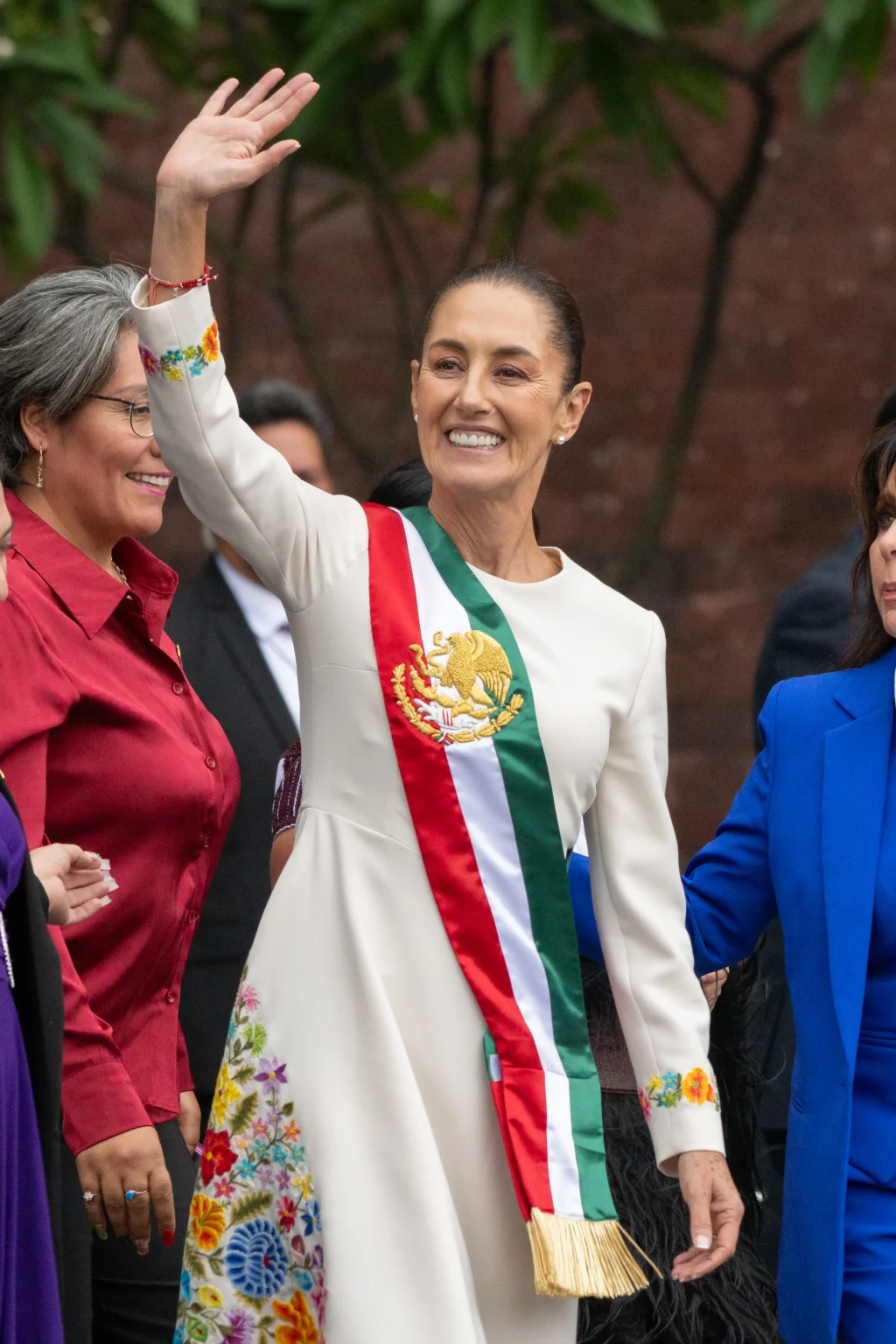
Photo: Presidencia de la República / Wikimedia Commons
On October 1, 2024, Claudia Sheinbaum Pardo placed her hand against her lapel in the Chamber of Deputies, bowed her head slightly, and accepted the red, white, and green presidential sash from veteran leftist icon Ifigenia Martínez. The hall erupted. Two centuries after Mexico declared independence from Spain, a woman had finally taken the helm of the republic. But look beyond the symbolism. Sheinbaum is not a product of backroom deal-making or military barracks. She is an engineer. A thermodynamicist. A physicist who spent years calculating combustion equations and industrial carbon output before ever running a municipality.
That technical background defines her entire public persona. Where her predecessor and longtime mentor Andrés Manuel López Obrador governed with folksy rhetoric and sprawling four-hour morning homilies, Sheinbaum works with spreadsheets, graphs, and diagnostic audits. She speaks plainly. She rarely raises her voice. Her political rise represents an unusual experiment in North American governance: putting an actual climate scientist in charge of a nation of 130 million people.
| Full Name | Claudia Sheinbaum Pardo |
|---|---|
| Date of Birth | June 24, 1962 |
| Current Age | 64 years old (as of November 2026) |
| Birthplace | Mexico City, Mexico |
| Height | 1.62 m (162 cm / 5 ft 4 in) |
| Political Party | Morena (National Regeneration Movement) |
| Current Office | President of Mexico (assumed office October 1, 2024) |
| Key Past Offices | Head of Government of Mexico City (2018–2023), Mayor of Tlalpan (2015–2017), Environment Secretary (2000–2006) |
| Education | BS in Physics (UNAM), MS & PhD in Energy Engineering (UNAM / Lawrence Berkeley National Laboratory) |
| Spouse | Jesús María Tarriba (m. 2023); Carlos Ímaz Gispert (m. 1987; div. 2016) |
| Children | Mariana Ímaz Sheinbaum (daughter); Rodrigo Ímaz Alarcón (stepson) |
Early Life, Academic Heritage, and Scientific Training
Sheinbaum grew up surrounded by books, pipettes, and political leaflets. Born in Mexico City in 1962, her family background brought together two distinct waves of Jewish diaspora. Her father, Carlos Sheinbaum Yoselevitz, was a chemical engineer whose Ashkenazi parents had arrived from Lithuania during the 1920s. Her mother, Annie Pardo Cemo, is a Sephardic biologist whose family emigrated from Bulgaria. Pardo went on to become an acclaimed cellular biologist and professor emeritus at the National Autonomous University of Mexico (UNAM), spending decades uncovering the cellular mechanisms behind pulmonary fibrosis.
Politics came with the dinner table. Both parents had participated in the 1968 student demonstrations that ended in the Tlatelolco massacre. It left a lasting impression on Sheinbaum.
When she entered UNAM’s Faculty of Sciences in 1982 to study physics, she did not keep her head down in the lecture hall. By 1986, the university administration proposed sweeping changes: charging tuition, eliminating automatic admissions for affiliated high schools, and curbing student democracy. Sheinbaum joined the frontlines of the Consejo Estudiantil Universitario (CEU). She organized strike committees, debated administrators, and spoke at mass assemblies. It was during these intense student protests that she met Carlos Ímaz Gispert, another charismatic student leader who would become her first husband.
The strike succeeded. Tuition remained free. Yet while dozens of her student comrades rushed straight into party apparatuses, Sheinbaum walked back into the lab. She wanted the credentials.
She completed her bachelor’s in physics in 1989. Next came a master’s in energy engineering in 1992. Then she packed her bags for California. From 1991 to 1994, Sheinbaum conducted her doctoral dissertation work at the renowned Lawrence Berkeley National Laboratory. Her focus was unglamorous but vital: industrial energy consumption, thermodynamic efficiency, and greenhouse emissions across Mexico’s manufacturing core. In 1995, she defended her thesis, becoming the first woman to earn a doctorate in energy engineering at UNAM.
Over the next five years, Sheinbaum taught, wrote textbooks, and published dozens of peer-reviewed articles. She gained international standing as an energy modeling specialist. When the Intergovernmental Panel on Climate Change (IPCC) convened experts for its Fourth Assessment Report, Sheinbaum was brought on board as a contributing author for Working Group III, examining practical options for mitigating global climate change. In late 2007, the IPCC and Al Gore were awarded the Nobel Peace Prize.
Public Service: Clean Transit and Mexico City Governance
In November 2000, Sheinbaum’s life changed with a phone call. Andrés Manuel López Obrador had just won election as Mexico City’s mayor and wanted an environmental secretary who understood hard data, not backroom patronage. He picked Sheinbaum. The capital was choked by ozone alerts and gridlock.
Sheinbaum did not hesitate. She proposed something radical for Mexico City at the time: taking street space away from private automobiles. That led directly to the Metrobús, a bus rapid transit system with dedicated lanes that launched along the spine of Avenida de los Insurgentes. Private minibus syndicates fought the move with street blockades. Sheinbaum pushed ahead, negotiating route concessions and proving the transit times dropped significantly.
She also oversaw the engineering of the second tier of the Anillo Periférico, an elevated highway project designed to untangle traffic jams in the south of the capital, while reforming vehicle emissions centers to eliminate rampant bribery rings. In 2006, when López Obrador stepped down to run for president, Sheinbaum left city hall. She resumed her academic post at UNAM but remained AMLO’s primary sounding board on energy policy.
Mayor of Tlalpan and Head of Government
In 2014, when López Obrador broke away from the establishment left to establish Morena, Sheinbaum was among the original signers. A year later, she ran for Mayor of Tlalpan, Mexico City’s sprawling southern borough. She won. But her term ran straight into tragedy on September 19, 2017, when a 7.1 magnitude earthquake struck central Mexico.
The private Colegio Enrique Rébsamen collapsed, killing 19 children and seven staff members. Investigations soon revealed illegal third-story construction authorized by corrupt past borough officials. Sheinbaum faced fury from grieving families and aggressive attacks from political opponents. She opened the borough’s archives to prosecutors, released blueprints publicly, and demanded arrest warrants for structural inspectors who had forged safety paperwork.
In July 2018, Sheinbaum won the race for Head of Government of Mexico City with 47% of the vote. She took over a police department plagued by corruption and a transit grid falling behind demand. She created the Digital Agency for Public Innovation (ADIP), slashing municipal bureaucratic red tape from 2,000 paperwork procedures to under 500, introducing digital driver’s licenses, and installing over 30,000 free public Wi-Fi hubs across every district.
Her most popular transportation initiative was the Cablebús. These electric aerial tram lines connected isolated, working-class neighborhoods on steep hillsides in Iztapalapa and Gustavo A. Madero directly to the metro grid, turning a grueling two-hour slog into a smooth 35-minute commute.
Then came the twin crises. During the 2020 COVID-19 outbreak, Sheinbaum quietly parted ways with the federal government’s dismissive stance on testing, setting up massive neighborhood swab kiosks and real-time hospital dashboards. In May 2021, disaster struck when an elevated span of Metro Line 12 collapsed near Olivos station, killing 26 people. Rather than defending the contractors, Sheinbaum hired Norwegian forensic firm DNV for an independent structural audit, forced billionaire Carlos Slim’s Grupo Carso to pay for line reconstruction without dipping into taxpayer coffers, and oversaw extensive steel retrofitting before resuming operations.
The 2024 Presidential Election and Global Role
In June 2023, Sheinbaum resigned from City Hall to enter Morena’s national primary contest. She toured all 32 Mexican states, speaking at packed town halls. When the internal survey results were unsealed in September 2023, she had swept every single poll.
The June 2, 2024 general election turned into a rout. Sheinbaum racked up 35.9 million votes—nearly 60% of the total—beating opposition coalition candidate Xóchitl Gálvez by over 30 points. It was the highest raw vote count in Mexico’s democratic history.
She walked into the National Palace on October 1, 2024, during an era of significant international realignments. Her tenure intersects with leadership shifts across the world, from the election of British Prime Minister Keir Starmer in London to complex diplomatic relationships alongside Canadian Prime Minister Justin Trudeau within North America. In continental Europe, leaders like Italian Prime Minister Giorgia Meloni and French President Emmanuel Macron reflect how different political cultures navigate executive power.
As president, Sheinbaum has focused heavily on industrial nearshoring, cross-border logistics, solar park expansions in Sonora, and reviving passenger rail lines across central Mexico. She defends state sovereignty in energy while actively courting foreign technology manufacturing.
Personal Life, Marriage, and Financial Disclosure
Outside of politics, Sheinbaum lives unpretentiously. In 1987, she married student leader Carlos Ímaz Gispert. They had a daughter, Mariana Ímaz Sheinbaum, who earned a PhD in comparative literature and works as an academic. Sheinbaum also raised Carlos Ímaz’s son from an earlier marriage, Rodrigo Ímaz Alarcón, a documentary filmmaker and artist whom she considers her son. The marriage lasted nearly thirty years before ending in divorce in 2016.
In late 2023, Sheinbaum surprised the Mexican press by announcing her marriage to Jesús María Tarriba Unger. Tarriba, a financial risk analyst at the Bank of Mexico, had been her classmate in physics lectures at UNAM in the 1980s. After decades living separate lives—Tarriba spent years working at Santander in Spain—they reconnected over Facebook, started dating again, and married in a private, quiet civil ceremony.
Under Mexico’s national public registry laws (*Declaranet*), Sheinbaum is required to declare all personal assets annually. Her disclosures are remarkably straightforward: her government salary, a single apartment in Mexico City, and routine domestic savings accounts. She owns no private corporate conglomerates, ranches, or luxury yachts. Online blogs claiming she possesses a net worth of $5 million to $10 million are inventing figures out of thin air, with zero backing from audited tax records.
Claudia Sheinbaum Social Media Presence & Verified Accounts
President Claudia Sheinbaum uses official social media channels to announce major infrastructure projects, publish daily press conferences (*Las Mañaneras del Pueblo*), and share updates on international summits. Below is a directory of her verified official platforms:
| Platform | Official Handle / Title | Verified Link |
|---|---|---|
| X (Twitter) | @Claudiashein | Visit Official X |
| @claudiashein | Visit Official Instagram | |
| Claudia Sheinbaum Pardo | Visit Official Facebook | |
| YouTube | @ClaudiaSheinbaumP | Visit Official YouTube |
| Official Website | Presidencia de la República | Visit Official Portal |
Frequently Asked Questions About Claudia Sheinbaum
Question: How tall is Claudia Sheinbaum?
Answer: Claudia Sheinbaum stands 1.62 meters tall (162 cm), which translates to approximately 5 feet 4 inches. She directly confirmed her height during media conferences.
Question: How old is Claudia Sheinbaum?
Answer: Born on June 24, 1962, Claudia Sheinbaum is 64 years old as of November 2026.
Question: What degrees does Claudia Sheinbaum have?
Answer: She holds a bachelor’s degree in physics (1989), a master’s in energy engineering (1992), and a PhD in energy engineering (1995) from UNAM, having conducted doctoral dissertation research at Lawrence Berkeley National Laboratory in California.
Question: Did Claudia Sheinbaum share a Nobel Peace Prize?
Answer: Yes, as a contributing author to Working Group III of the Intergovernmental Panel on Climate Change (IPCC) for the Fourth Assessment Report in 2007. The IPCC was jointly awarded the 2007 Nobel Peace Prize with Al Gore.
Question: Who is Claudia Sheinbaum’s husband?
Answer: She is married to Jesús María Tarriba Unger, a financial risk analyst at the Bank of Mexico, whom she married in November 2023. She was earlier married to Carlos Ímaz Gispert from 1987 until their divorce in 2016.
Question: What political party does Claudia Sheinbaum belong to?
Answer: She is a member of Morena (National Regeneration Movement), having helped establish the party in 2014 after earlier activity in the Party of the Democratic Revolution (PRD).