Azim Premji Biography: Age, Height, Wipro Story, Family & $21B Philanthropy
Azim Premji turned an Amalner cooking oil mill into global tech powerhouse Wipro, before transferring $21B+ into India’s largest philanthropic education endowment.
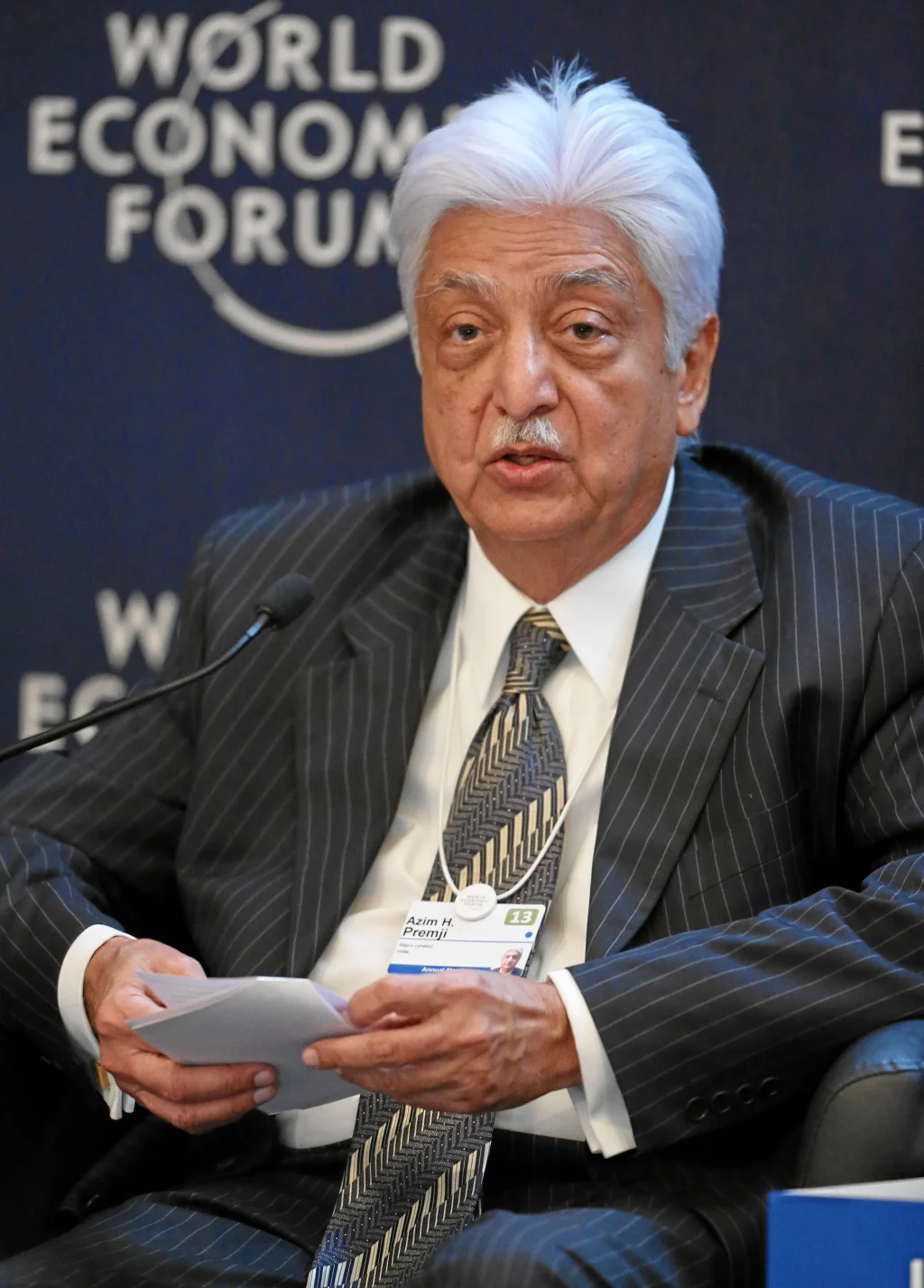
Photo: World Economic Forum / CC BY-SA 2.0
In the sweltering summer of 1966, a Western Union telegram arrived at Stanford University that ended Azim Premji’s youth in an instant. His father, Muhammed Hashim Premji, had died of a sudden heart attack in Bombay at fifty-one. Premji dropped his slide rule, packed a single suitcase, and took the first flight home. Within days he found himself standing in front of an agitated shareholders meeting in Amalner, a dusty railway town in Maharashtra’s Jalgaon district. A shareholder stood up, looked at the twenty-one-year-old in the eye, and told him bluntly to sell his equity to someone who actually knew how to run an oil press.
Premji refused to sell. He stayed.
Over the next fifty-three years, he transformed Western Indian Vegetable Products—then churning out tins of Sunflower Vanaspati cooking oil and yellow cakes of 787 laundry soap—into Wipro Limited, an international technology juggernaut employing hundreds of thousands across dozens of countries. When IBM packed its bags and left India in 1977 over foreign equity caps, Premji jumped into the hardware vacuum. When microcomputer hardware commoditized, he pivoted into custom enterprise software. By October 2000, he was ringing the opening bell at the New York Stock Exchange.
Then came the act that set him apart from nearly every industrial tycoon of his generation. Starting in 2001, Premji began transferring massive blocks of his Wipro shares into an irrevocable philanthropic trust. By 2019, those transfers exceeded $21 billion (over ₹1.45 lakh crore). He became the first Indian signatory to The Giving Pledge, channeling his vast wealth into public primary school reform, district teacher institutes, and university campuses across India’s poorest districts.
Azim Premji Quick Biography Facts
| Full Name | Azim Hashim Premji |
|---|---|
| Date of Birth | 24 July 1945 |
| Current Age | 81 years old (as of November 2026) |
| Birthplace | Bombay (now Mumbai), Maharashtra, India |
| Height | 170 cm (approx. 5 ft 7 in / 1.70 m) |
| Education | St. Mary’s School (Mumbai); Bachelor of Science in Electrical Engineering, Stanford University (completed 2000) |
| Occupation | Industrialist, Technology Entrepreneur, Philanthropist |
| Company Leadership | Founder Chairman & Non-Executive Director, Wipro Limited; Executive Chairman (1966–2019) |
| Father | Muhammed Hashim Premji (Founder of Western Indian Vegetable Products) |
| Mother | Dr. Gulbanoo Premji (Physician & Children’s Hospital Founder) |
| Spouse | Yasmeen Premji |
| Children | Rishad Premji (Executive Chairman, Wipro), Tariq Premji |
| Major Philanthropic Vehicle | Azim Premji Foundation & Azim Premji University (over $21 billion endowed) |
| National Honours | Padma Bhushan (2005), Padma Vibhushan (2011), Chevalier de la Légion d’Honneur (2018) |
Early Roots in Bombay and Stanford Studies Cut Short
Azim Premji was born in Bombay on 24 July 1945, just weeks before the end of the Second World War. The family belonged to the Gujarati Nizari Ismaili Khoja community. His father, Muhammed Hashim Premji, was an assertive commodity trader who had earned the moniker “Rice King of Burma” before establishing Western Indian Vegetable Products Ltd in Amalner in 1945. In August 1947, as the subcontinent fractured into two dominions, Muhammad Ali Jinnah personally urged Hashim Premji to relocate to Karachi and assume the portfolio of Pakistan’s finance minister. Hashim Premji declined without hesitation. India was home, and Amalner was where his factory stood.
Young Azim went to St. Mary’s School in Mazagon, south Bombay. Yet his moral compass came straight from his mother, Dr. Gulbanoo Premji. She was a qualified physician who never practiced medicine for private profit. Instead, she spent nearly five decades building and running a charitable children’s orthopedic hospital in Bombay, rehabilitating children disabled by polio and cerebral palsy. Her son watched her manage accounts, nurse patients, and work seven days a week without taking a rupee for herself.
By the early 1960s, Premji headed across the Pacific to Palo Alto, enrolling in Stanford University’s electrical engineering department. Like fellow Indian-origin technology entrepreneur Vinod Khosla, who arrived in northern California years later, Premji found himself captivated by Silicon Valley’s burgeoning computing scene. But in 1966, during his senior year, his father died suddenly. Studies stopped. The family called him home.
Pivoting from Peanut Oil to Enterprise Silicon
Amalner was no high-tech paradise. Power cuts struck daily. Dust coated everything. The factory crushed groundnuts into cooking oil, packed laundry cakes, and sold residual oilcake for cattle feed. Premji spent his first eighteen months on the factory floor in simple shirts, clocking sixteen-hour shifts, studying transport bills, and fixing solvent extraction inefficiencies. Soon, he expanded product lines into hydrogenated bakery fats, toilet soaps, baby toiletries, and hydraulic cylinders for commercial dump trucks.
Then came the turning point: 1977. George Fernandes, industries minister in the newly sworn-in Morarji Desai cabinet, strictly applied the Foreign Exchange Regulation Act. IBM refused to hand over 60% of its equity to local partners and abruptly pulled out of India. Hundreds of Indian banks, government ministries, and universities were left stranded without mainframe support or desktop machines.
Premji moved fast. In 1977, he renamed the enterprise Wipro Products Limited, formally dropping “Vegetable” from the corporate letterhead, before settling on Wipro Limited in 1982. He traveled to Bengaluru, recruited top electronics talent from the Indian Institute of Science (IISc), and built an R&D team to engineer indigenous microcomputers. By 1981, Wipro had assembled its first commercial computer based on the Intel 8086 chip—well ahead of most domestic competitors.
When the personal computer market turned into a low-margin commodity race in the late 1980s, Premji pivoted again. He pushed Wipro into bespoke software development, hardware design, and offshore IT maintenance. Alongside contemporaries like Nandan Nilekani at Infosys, Premji demonstrated to sceptical American and European multinationals that Indian engineers could manage mission-critical banking, airline, and telecom software with clockwork precision.
In October 2000, Wipro listed its American Depositary Shares on the New York Stock Exchange. That same year, thirty-four years after receiving the telegram that pulled him away from California, Premji quietly completed his remaining coursework and received his Bachelor of Science in Electrical Engineering from Stanford University.
Trusteeship and the $21 Billion Philanthropic Endowment
Azim Premji’s frugality is legendary across corporate India. He drove a modest second-hand Ford Escort for years, flew economy class on domestic commercial flights, stayed in company transit guesthouses rather than five-star suites, and regularly walked around Wipro’s Sarjapur campus after dark flicking off unattended office lights. To outsiders, it looked like eccentric penny-pinching. To Premji, it was a practical moral discipline borrowed directly from Mahatma Gandhi’s philosophy of trusteeship: the principle that business owners are merely caretakers of wealth that belongs to the wider public.
In 2001, he put that philosophy into irrevocable practice by creating the Azim Premji Foundation. Rather than signing checks for showy galas, he focused on a quiet, grinding, unglamorous problem: the quality of learning in rural government primary schools. Foundation teams moved into backward districts across Karnataka, Rajasthan, Uttarakhand, Chhattisgarh, and Madhya Pradesh. They didn’t replace government schools; they worked alongside civil-service teachers, revamping curricula, training headmasters, and diagnosing foundational reading deficits.
In 2010, the foundation opened Azim Premji University in Bengaluru under a state legislative charter, dedicated specifically to training educationists, public policy researchers, and development professionals. In 2013, Premji signed The Giving Pledge, committing to donate more than half of his wealth. Other Indian corporate pioneers like Kiran Mazumdar-Shaw later joined the pledge, establishing a new culture of institutional giving across the subcontinent.
In March 2019, Premji transferred an additional 34% of Wipro shares held by his personal entities to the endowment trust. That single transfer pushed his cumulative irrevocable endowment past $21 billion (₹1.45 lakh crore). It stands as one of the largest private philanthropic endowments on earth, rivaling the Wellcome Trust and the Ford Foundation. When the COVID-19 pandemic swept across India in 2020 and 2021, the Azim Premji Foundation and Wipro deployed over ₹2,125 crore in frontline medical facilities, diagnostic labs, and food distribution across rural districts.
Corporate Governance and Passing the Baton
In July 2019, after fifty-three uninterrupted years at the helm, Azim Premji stepped down as Executive Chairman of Wipro. He transitioned to Founder Chairman and Non-Executive Director. His elder son, Rishad Premji, a Harvard Business School graduate who had spent years at Bain & Company before serving as Wipro’s Chief Strategy Officer, assumed the role of Executive Chairman.
Premji’s family life has remained deliberately detached from the tabloid circuit. He lives in Bengaluru with his wife, Yasmeen Premji, a novelist and former architectural writer. Their younger son, Tariq Premji, works closely with Premji Invest, the family office whose investment yields feed directly into the philanthropic foundation. Drawing parallels to the generational transition steered by Adi Godrej, Premji ensured that Wipro’s executive leadership remained driven by professional chief executives, preserving a clear barrier between family ownership and operational management.
In 2024, the Lucknow bench of the Allahabad High Court quashed a frivolous criminal complaint regarding contractor compliance that had named Premji, noting in its verdict that he had spent over five decades building an unblemished record of transparent corporate governance.
Azim Premji Social Media Presence & Verified Accounts
Azim Premji maintains no personal social media profiles on platforms like X (Twitter), Instagram, Facebook, or LinkedIn. His public announcements, foundation field reports, and academic lectures are distributed exclusively through verified institutional portals.
| Platform / Organization | Account Handle / Channel | Link |
|---|---|---|
| Azim Premji Foundation | Official Portal | azimpremjifoundation.org |
| Azim Premji University | Institutional Portal | azimpremjiuniversity.edu.in |
| Wipro Corporate | Official Global Portal | wipro.com |
| Wipro Official (X/Twitter) | @Wipro | x.com/Wipro |
| Azim Premji University (X/Twitter) | @azimpremjiuniv | x.com/azimpremjiuniv |
| Azim Premji University (YouTube) | @AzimPremjiUniv | youtube.com/@AzimPremjiUniv |
Frequently Asked Questions About Azim Premji
What is Azim Premji’s height?
Azim Premji stands approximately 170 cm tall, which equals 5 feet 7 inches (1.70 m).
How old is Azim Premji?
Azim Premji was born on 24 July 1945 in Bombay (now Mumbai), Maharashtra, India. As of November 2026, he is 81 years old.
What was Wipro’s original business before software?
Wipro was founded in 1945 as Western Indian Vegetable Products Ltd in Amalner, Maharashtra. It originally manufactured Sunflower Vanaspati cooking oil, 787 laundry soap, and cattle feed. It entered microcomputers in 1977 following IBM’s departure from India, and shifted to enterprise software services in the 1980s.
Did Azim Premji finish his degree at Stanford University?
Yes. Premji paused his studies at Stanford in 1966 when his father died. Thirty-four years later, in 2000, he completed his remaining coursework and received his Bachelor of Science in Electrical Engineering.
How much has Azim Premji given away to charity?
Premji has transferred over $21 billion (more than ₹1.45 lakh crore) in economic ownership to the Azim Premji Foundation endowment trust, making him the most generous living philanthropist in Asia.
Who leads Wipro today?
Azim Premji retired as Executive Chairman in July 2019 and serves as Founder Chairman and Non-Executive Director. His son, Rishad Premji, serves as Executive Chairman, working alongside professional executive leadership.