Jensen Huang Biography: Age, Height, Education, Net Worth & NVIDIA Story
Comprehensive, verified biography of NVIDIA co-founder Jensen Huang: age, height facts, Oregon State and Stanford education, Denny’s founding origin, CUDA gamble, net worth, and verified social accounts.
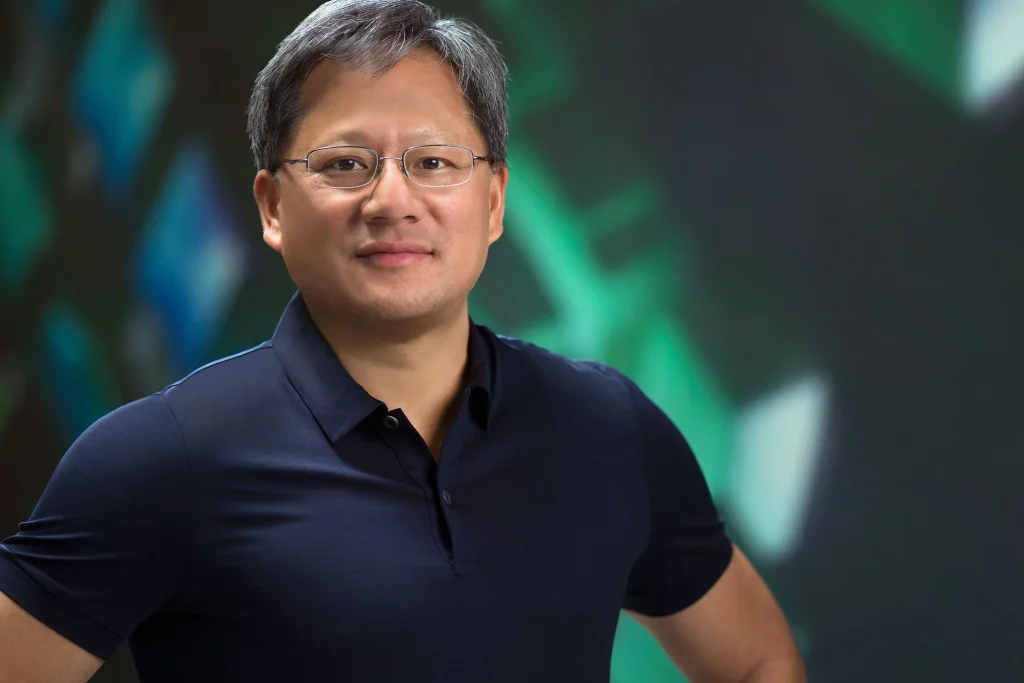
Photo: NVIDIA Corporation / Wikimedia Commons (CC BY-SA 2.0)
In April 1993, Jensen Huang sat in a booth at a Denny’s diner off Berryessa Road in San Jose, splitting cups of coffee with Chris Malachowsky and Curtis Priem. Most engineers at the time obsessed over central processors. CPUs handled math in neat single files. Huang and his partners bet that personal computers would soon choke on that bottleneck. They believed the future belonged to parallel processing—firing off thousands of arithmetic chores all at once to render lifelike 3D geometry on home monitors.
They called the company NVIDIA.
Three decades later, that graphic chip gamble ended up powering the global artificial intelligence boom. Huang steered the business through near-bankruptcy in the late nineties, coined the term “Graphics Processing Unit” with the GeForce 256 in 1999, and sank billions into the CUDA software architecture when Wall Street analysts begged him to cut spending. By 2025, those stubborn engineering calls pushed NVIDIA past a five-trillion-dollar market capitalization, transforming a scrappy startup into the central utility of the computing world before Huang stepped aside from executive operations in late 2026.
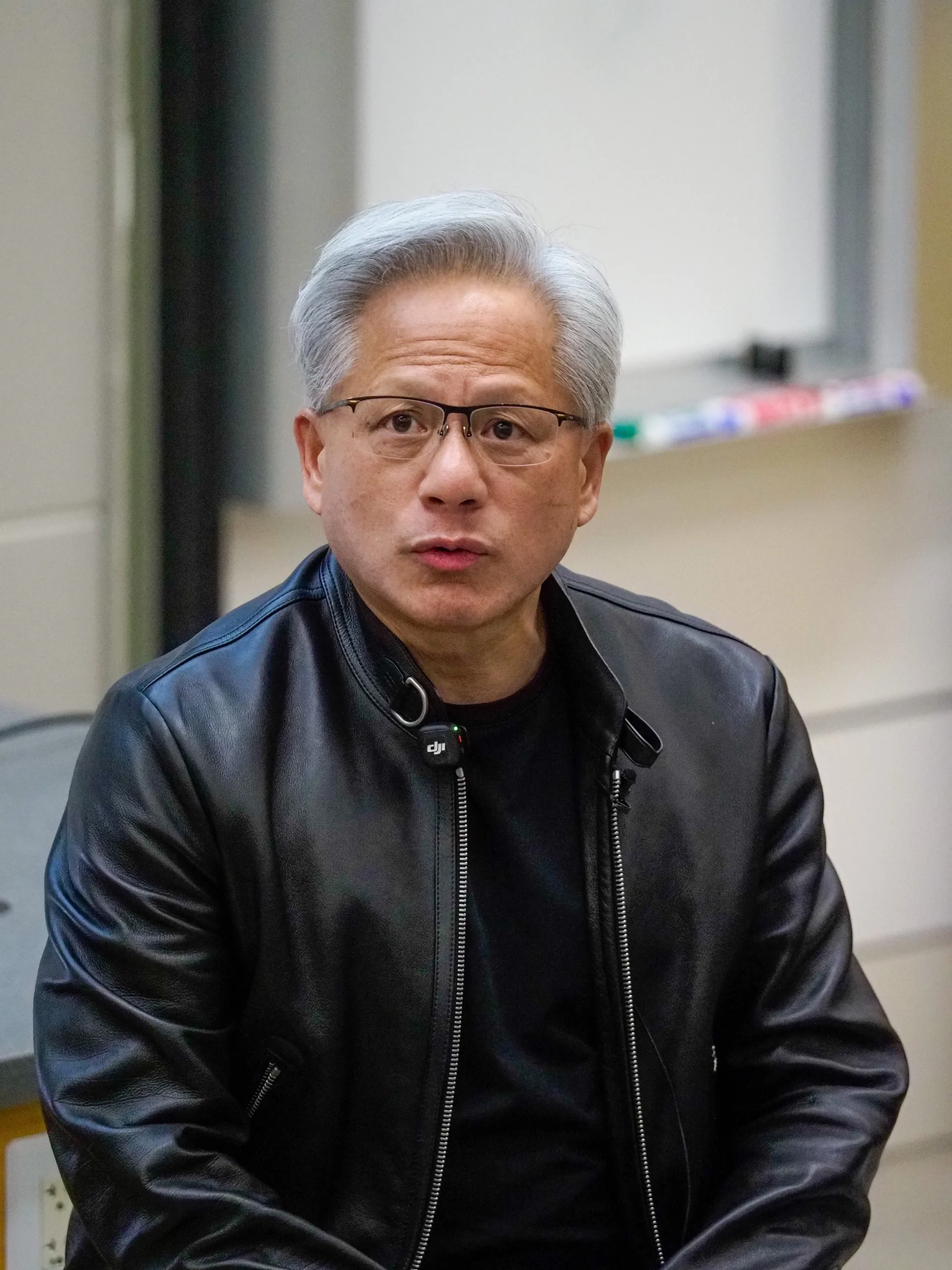
He did it wearing the same uniform for twenty years: dark jeans, black sneakers, and a tailored black leather motorcycle jacket.
Jensen Huang: Quick Biography Facts
| Full Name | Jen-Hsun Huang (黃仁勳) |
|---|---|
| Date of Birth | February 17, 1963 |
| Age | 63 years old (as of November 2026) |
| Birthplace | Tainan, Taiwan |
| Nationality | Taiwanese, American |
| Estimated Height | Approximately 5 ft 7 in (170 cm); biographical estimate (not published in corporate filings) |
| Education | Oregon State University (BSEE, 1984); Stanford University (MSEE, 1992) |
| Profession | Electrical Engineer, Silicon Valley Executive, Entrepreneur |
| Known For | Co-founding NVIDIA, launching the modern GPU, creating CUDA, scaling AI compute infrastructure |
| Spouse | Lori Mills Huang (married 1985) |
| Children | Madison Huang, Spencer Huang |
| Major Awards | IEEE Founders Medal, SIA Robert N. Noyce Award, National Medal of Science, IEEE Medal of Honor (2026) |
Early Life: Kentucky Reform School to Oregon Tables
Jen-Hsun Huang was born in Tainan, Taiwan, in 1963. When he turned five, his family moved to Thailand. But regional tensions escalated quickly during the Vietnam War era. Anxious about their sons’ safety, his parents shipped nine-year-old Jensen and his older brother to the United States to stay with an uncle in Tacoma, Washington.
The uncle misread a brochure. Thinking he had found a prestigious rural boarding school, he sent the boys to Oneida Baptist Institute in eastern Kentucky. It was actually a strict reform academy for troubled teens. Huang was nine years old, spoke minimal English, and found himself assigned to scrub dormitory toilets every single afternoon. He weathered fistfights in the hallways and earned peace by tutoring seventeen-year-old roommates in algebra.
The family finally reunited once his parents secured green cards, settling in Aloha, Oregon. Huang threw his spare energy into competitive table tennis. He trained daily until he ranked among the top junior singles players in the country. He burned through high school courses just as fast, graduating from Aloha High at 16.
Engineering Roots: Oregon State Lab Benches and Stanford Nights
Huang headed south down Interstate 5 to Corvallis, enrolling in electrical engineering at Oregon State University. On the first day of an introductory lab class, he walked up to his assigned workstation and met Lori Mills. He told her he would impress her with his homework grades. They studied together, graduated in 1984, and married in 1985.
Silicon Valley hired him immediately. Huang started out designing microprocessors at Advanced Micro Devices, then jumped to LSI Logic to run coreware engineering. The work ran long hours, but Huang wanted deeper math. He enrolled in Stanford University’s night school cooperative program, grinding through graduate circuits and semiconductor physics until finishing his master’s degree in 1992.
That technical footing set him apart from conventional MBA executives. Like Sundar Pichai’s journey leading Alphabet, Huang approached business strategy from physical limits, transistor budgets, and architectural bottlenecks rather than marketing decks.
The Denny’s Hustle and the Near-Death of NVIDIA
Huang knew Denny’s intimately. He had worked as a teenager wiping tables and scrubbing dishwashers at a Portland franchise, a gig he insisted taught him how to look people in the eye and handle pressure. So when he, Priem, and Malachowsky decided to start their own chip venture in the spring of 1993, a booth at the San Jose Denny’s was the natural office.
Their opening product nearly sank them.
The NV1 chip, launched in 1995, gambled on curved quadratic texture surfaces instead of flat polygons. It sounded elegant on paper. But Microsoft rolled out Direct3D around standard polygonal rendering, rendering NV1 obsolete overnight. Cash drained fast. Creditors circled. Huang had to lay off half his staff, renegotiate supplier terms with Sega, and funnel every surviving dollar into one desperate redesign: the RIVA 128.
The RIVA 128 shipped in 1997. It delivered blistering 3D frame rates at half the price of competing boards, moving more than a million units in four months. Cash poured back into the balance sheet. In 1999, NVIDIA listed on Nasdaq and introduced the GeForce 256. By moving coordinate transforms and dynamic lighting directly onto the graphics die, Huang established the GPU as a distinct computing category.

The Billions Burned on CUDA
In 2006, Huang made an engineering choice that terrified Wall Street. He greenlit CUDA.
Until then, graphics chips were locked boxes built strictly for games like Doom and Quake. CUDA broke those boxes open, letting developers write standard C code that harnessed the thousands of tiny math cores packed inside every GeForce card. The catch? Adding CUDA logic inflated silicon size and manufacturing costs on every chip NVIDIA shipped, while almost no software developers were paying for it.
Analysts repeatedly hammered the stock. Margins shrank. For nearly six years, investors questioned why Huang was burning cash on an academic curiosity. Huang ignored them. He kept distributing CUDA into every retail graphics card sold, waiting for software researchers to hit a processing wall on standard Intel chips.
The dam broke in 2012. University of Toronto researchers trained AlexNet on two off-the-shelf gaming GPUs, crushing rival error rates in visual object classification. Machine learning had found its hardware engine. A decade later, when ChatGPT triggered the modern artificial intelligence wave, NVIDIA sat completely uncontested. Every major hyperscaler needed H100 and Blackwell server racks.
That kind of stubborn, decade-long commitment to unproven science mirrors Kiran Mazumdar-Shaw’s biotechnology leadership in biopharmaceuticals and Nikhil Kamath’s entrepreneurial path in discount financial trading. It proved that deep infrastructure bets demand years of quiet execution before the market catches up.
Management Habits, Flat Desks, and Philanthropy
Inside NVIDIA’s Santa Clara headquarters, Huang ran a structure that baffled business schools. No one-on-one reviews. No rigid departmental silos. Huang maintained between forty and fifty direct reports, preferring to solve operational messes in open meetings where entry-level software developers could challenge vice presidents.
His closet was equally stripped of friction. Black denim, black slip-ons, and a rotation of dark leather jackets. Asked why he never switched wardrobes, Huang replied that picking clothes was a waste of cognitive load better spent on chip tape-outs.
Together with Lori, Huang poured hundreds of millions into technical education through their family foundation. They contributed $30 million to build the Jen-Hsun Huang Engineering Center at Stanford in 2010. In 2022, they pledged $50 million to Oregon State University to erect the Collaborative Innovation Complex, outfitting the campus with a dedicated supercomputing center for climate research. That impulse to back tangible institutions matches the long-range perspective seen in founder journeys like Vineeta Singh’s founder journey in consumer industries.
Jensen Huang Social Media Presence & Verified Accounts
Huang interacts publicly through university lectures, keynote addresses, and official business channels. Here are the verified portals to his presence and primary corporate communications:
| Platform | Verified Handle / Profile | Status & Link |
|---|---|---|
| X (Twitter) | @JensenHuang | Visit Official Profile |
| Official Website | NVIDIA Corporation | Visit Website |
| Executive Newsroom Bio | NVIDIA Executive Profile | View Executive Dossier |
| YouTube | NVIDIA Official Channel | Watch Keynotes & Talks |
Frequently Asked Questions
Question: What is Jensen Huang’s height?
Answer: Jensen Huang is estimated at approximately 5 feet 7 inches (170 cm) based on industry event appearances. His height is not listed on SEC filings or corporate documentation.
Question: How old is Jensen Huang and when was he born?
Answer: Jensen Huang was born on February 17, 1963, in Tainan, Taiwan. As of November 2026, he is 63 years old.
Question: Where did Jensen Huang go to college?
Answer: Huang received his Bachelor of Science in Electrical Engineering from Oregon State University in 1984, followed by a Master of Science in Electrical Engineering from Stanford University in 1992.
Question: Who is Jensen Huang’s wife?
Answer: Jensen Huang is married to Lori Mills Huang. The pair met as lab partners in an electrical engineering class at Oregon State University and married in 1985. They have two adult children, Madison and Spencer.
Question: How did NVIDIA start?
Answer: Jensen Huang co-founded NVIDIA in April 1993 with Chris Malachowsky and Curtis Priem. They developed the business plan inside a Denny’s diner in San Jose, aiming to build chips that accelerated 3D graphics for PC gamers.
Question: What is Jensen Huang’s net worth?
Answer: Forbes estimates Jensen Huang’s net worth at over $140 billion. His wealth is almost entirely tied to his equity stake in NVIDIA Corporation and moves up and down daily with public stock market trading.