Léon Marchand Biography: Age, Height, Olympic Medals, Parents, Career & Verified Facts
Comprehensive verified biography of French swimming icon Léon Marchand. Explore his Paris 2024 Olympic sweep, Bob Bowman coaching, height, family, and verified facts.
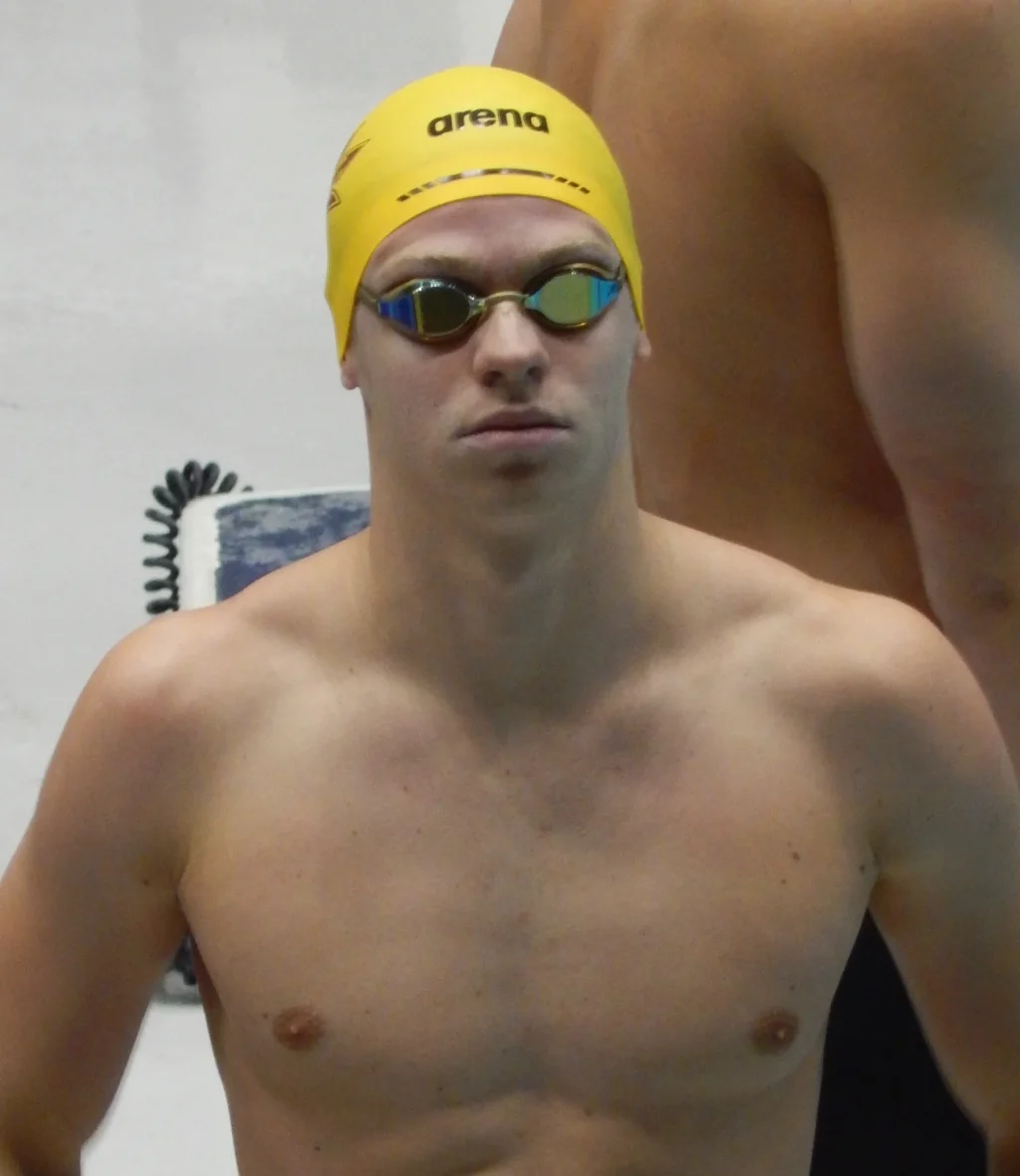
Photo: Tanis Coralee Leonhardi / Wikimedia Commons (CC BY-SA 4.0)
Most athletes spend an entire lifetime chasing a single flawless Olympic race. Léon Marchand got five in seven days. Inside a converted rugby stadium in Nanterre, with fifteen thousand fans shouting his name so loud the water trembled against the tiled gutters, he took the hardest schedule in modern swimming and dismantled it race by race.
France had waited twelve years for an Olympic swimming gold. Marchand did not merely win one. On July 28, 2024, he swam the 400-meter individual medley in 4 minutes, 2.95 seconds, taking nearly a second off Michael Phelps’ Olympic record. Seventy-two hours later, he pulled off something swimming historians had long considered suicidal: winning the 200m butterfly and the 200m breaststroke on the exact same evening, separated by less than two hours.
| Full Name | Léon Marchand |
|---|---|
| Date of Birth | May 17, 2002 |
| Current Age | 24 years old (as of November 2026) |
| Place of Birth | Toulouse, Haute-Garonne, France |
| Nationality | French |
| Height | 187 cm (approx. 6 ft 1.6 in / 6 ft 2 in); listed as 183 cm in early French swimming records |
| Weight | Approximately 77 kg (170 lbs) |
| Olympic Medals | 4 Gold (400m IM, 200m Fly, 200m Breast, 200m IM), 1 Bronze (4x100m Medley Relay) |
| World Championship Titles | 5 Gold Medals (Budapest 2022, Fukuoka 2023) |
| World Records | 400m Individual Medley (4:02.50, Fukuoka 2023) |
| Parents | Xavier Marchand and Céline Bonnet (both French Olympic swimmers) |
| Coaches | Bob Bowman (collegiate/pro coach), Nicolas Castel (Toulouse formative coach) |
| Collegiate Program | Arizona State Sun Devils (ASU), Tempe, Arizona |
| Field of Study | Computer Science |
The Toulouse Pedigree: Born into Olympic Swimming Royalty
Léon Marchand did not arrive at elite swimming accidentally. His DNA read like a French aquatic federation roster. His father, Xavier Marchand, swam the individual medley at the 1996 Atlanta and 2000 Sydney Games, taking world championship silver in Perth in 1998. His mother, Céline Bonnet, raced the medley and backstroke at the 1992 Barcelona Olympics. His uncle, Christophe Marchand, was an Olympic freestyler in Seoul and Barcelona.
Yet his parents did not push him. If anything, they held him back.
Growing up along the Garonne in Toulouse, Léon played judo on local tatamis and threw rugby balls across suburban pitches. He hated cold water. At age seven, he actually walked away from swimming lessons because he couldn’t stand the chill of the morning pool. It took nearly two years for him to return to the water at the Dauphins du TOEC club, and when he did, coach Nicolas Castel made sure the boy wasn’t drilled into early burnout.
Instead of grinding out endless laps in one specialty, Castel had Marchand train all four strokes equally. That technical balance paid off quickly. In 2019, aged seventeen, Marchand took the French senior 200m butterfly title in Rennes. Two years later at the French Olympic trials in Chartres, he dropped a 4:09.65 in the 400m individual medley, cutting his way onto the Tokyo 2020 roster. He reached the Olympic final in Tokyo as a teenager, finishing sixth in 4:11.16. That sixth-place finish told him he was close, but it also made something clear: to beat the world, he needed a different kind of daily pressure.
Moving to the Desert: Arizona State and Bob Bowman
In September 2020, Marchand sent a cold email to Bob Bowman in Tempe, Arizona. Bowman, the architect behind Michael Phelps’ twenty-three Olympic gold medals, knew what to look for on tape. He didn’t just look at Marchand’s times; he looked at his ankle flexibility and his streamline position off the turns.
Marchand landed in Arizona in the autumn of 2021, traded the cloudy skies of southwestern France for scorching desert heat, and enrolled as a computer science major at Arizona State University. College swimming in America is intense. Dual meets happen every few weeks. Training blocks are relentless. Swimming yards instead of meters forced Marchand to turn more frequently, and that was exactly what Bowman wanted.
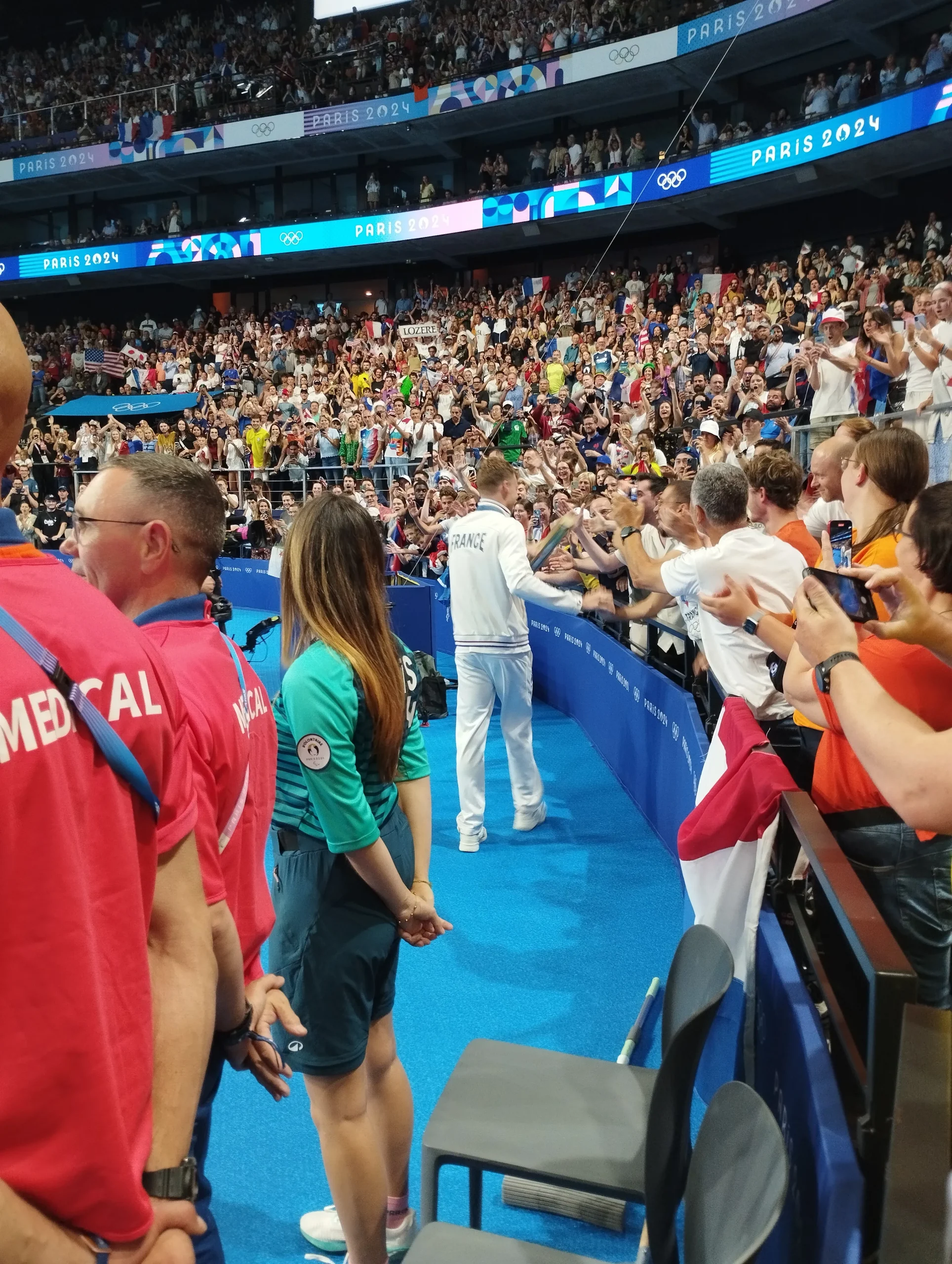
Bowman went to work on Marchand’s underwater dolphin kicking. Underwater kicks aren’t just an extra push; in short-course and long-course racing alike, they are the fastest speed a human body ever reaches in the pool. Marchand possessed an unusual ability to keep his core tight while generating propulsion from his hips without breaking his streamline. Bowman pushed him to stay submerged for fourteen meters on every single turn, right up to the legal fifteen-meter limit.
The results arrived fast. At the 2022 World Championships in Budapest, Marchand took golds in the 200m and 400m individual medleys. Then came Fukuoka in July 2023. In the 400m IM final, Marchand touched the wall in 4:02.50. He didn’t just shave the world record; he erased Michael Phelps’ 4:03.84 mark from Beijing 2008—the longest-standing individual world record on the books. Phelps was sitting fifty feet away in the television booth, watching his signature record fall to his coach’s new student.
Much like javelin thrower Neeraj Chopra discovered when relocating his training camps to Europe, Marchand found that elite international success demanded leaving familiar comforts behind to seek out world-class technical mentorship.
The Paris 2024 Masterpiece: Four Individual Golds in One Week
By the time the Paris 2024 Games opened, Marchand was carrying the emotional weight of an entire host country. His face looked down from billboards across the Metro. Every French sports daily led with his schedule.
He opened his campaign on July 28 in the 400-meter medley. The atmosphere inside Paris La Défense Arena was deafening. Marchand took the lead on the opening fly leg, pulled away on backstroke, destroyed the field on breaststroke, and came home in 4:02.95. He broke Phelps’ Olympic record by nearly a full second, while second-place finisher Tomoyuki Matsushita touched nearly six seconds later.
Then came Wednesday, July 31. This was the gamble.
At 8:37 PM, Marchand walked out for the 200-meter butterfly final. Standing on the blocks opposite him was Kristof Milak of Hungary, the Olympic champion and world record holder. Milak went out fast, leading by nearly a full body length at the 150-meter turn. Marchand came off the wall underwater, surfaced, and began grinding down the deficit stroke by stroke. With ten meters left, Milak locked up. Marchand surged past to touch in 1:51.21, setting an Olympic record.
He had less than ninety minutes to warm down, stretch, and step back onto the blocks for the 200-meter breaststroke. The muscle mechanics could not be more different: butterfly demands continuous explosive core undulation; breaststroke demands precise whip-kicks and hip rotation. Defending Olympic champion Zac Stubblety-Cook was waiting. Marchand led from the first fifty meters, pulled away through the middle hundred, and touched in 2:05.85 for another Olympic record. He became the first swimmer in history to win the 200 fly and 200 breaststroke at the same Olympic Games.
Two days later, on August 2, he completed the individual sweep by winning the 200m individual medley in 1:54.06, setting his fourth Olympic record in four individual races. Only Michael Phelps (2004, 2008) and Mark Spitz (1972) had ever won four individual golds at a single Olympics. Marchand added a fifth medal forty-eight hours later, anchoring France to bronze in the 4x100m medley relay alongside Yohann Ndoye-Brouard, Maxime Grousset, and Florent Manaudou.
That ability to remain composed under national scrutiny mirrored the multi-medal breakthrough of pistol shooter Manu Bhaker during the same summer, showing how elite athletes manage immense home expectations.
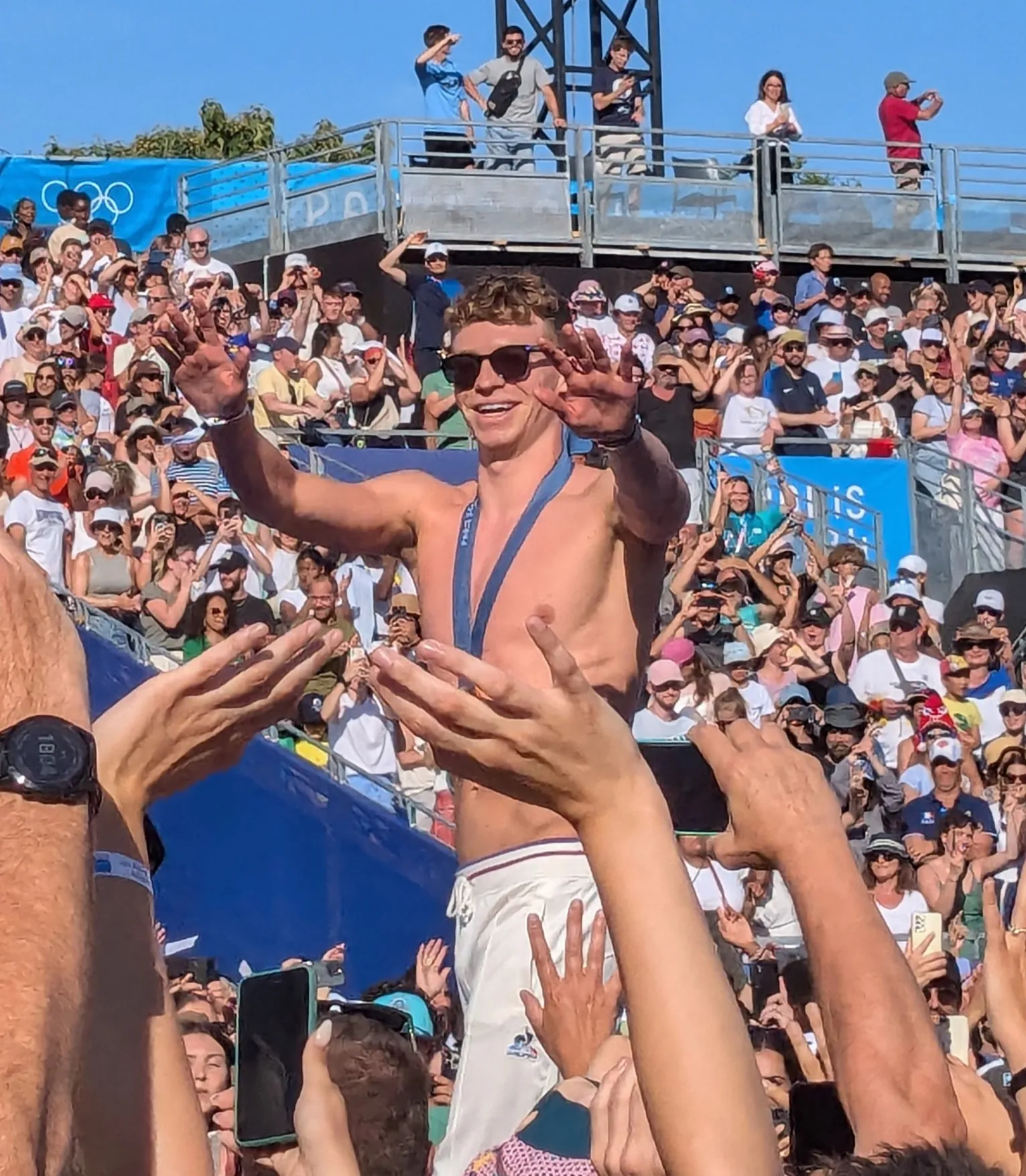
The Science of Marchand’s Underwater Mechanics
Swimming analysts spend hours dissecting Marchand’s underwater phases. Most elite swimmers lose speed rapidly after hitting the water on a flip turn. Marchand maintains velocity because his kicking amplitude remains identical whether he is fresh or fatigued.
Water drag increases with the square of speed, but surface waves multiply that drag significantly. By staying three to four feet beneath the surface on his breakouts, Marchand bypasses surface chop entirely. His kicks originate from his upper thoracic spine rather than his knees, which keeps his legs in the slipstream created by his shoulders.
There is also his physiological range. Butterflyers typically have tight hips and flexible ankles that point straight back; breaststrokers have open hips and ankle joints that rotate outward. Possessing both joint profiles is rare. It allows Marchand to transition between four distinct kicking styles without muscular resistance, giving him an unfair advantage in medley races where competitors invariably hit a weak leg.
That technical balance between endurance and raw mechanical efficiency is similar to the physical conditioning seen in multi-Olympic badminton medalist PV Sindhu and wrestling veteran Bajrang Punia, who built their careers on deep structural stamina.
Commercial Partnerships and Financial Facts
Marchand’s Olympic sweep instantly made him France’s most sought-after commercial face. Luxury conglomerate LVMH brought him on as a brand ambassador for Louis Vuitton, and Swiss luxury watchmaker Omega added him to their athlete roster alongside their Olympic timing sponsorship.
Online celebrity net worth portals claim Marchand is worth anywhere between two and fifteen million dollars. Those numbers are pure guesswork. French law does not require private citizens to publish tax returns, and Marchand’s management agency does not disclose the financial details of his commercial retainers. While his earnings increased substantially after Paris, any exact figure published online remains unverified.
Léon Marchand Social Media Presence & Verified Accounts
Fans tracking Marchand’s upcoming international meets, training camps, and official announcements can find his verified platforms below:
| Platform | Official Account Handle | Direct Verified Link |
|---|---|---|
| @leon.marchand31 | Instagram Profile | |
| X (formerly Twitter) | @leon_marchand | X Profile |
| leon.marchand.94 | Facebook Page | |
| YouTube | Official Athlete Channel | YouTube Channel |
| Équipe de France Profile | CNOSF Olympic Athlete Page | Official Athlete Profile |
Frequently Asked Questions About Léon Marchand
Question: How tall is Léon Marchand?
Answer: Léon Marchand stands 187 cm tall, which converts to approximately 6 feet 1.6 inches (commonly noted as 6 ft 2 in). Early youth swimming records with the French Swimming Federation listed him at 183 cm (6 ft 0 in).
Question: How old is Léon Marchand and when was he born?
Answer: Marchand was born on May 17, 2002, in Toulouse, France. As of November 2026, he is 24 years old.
Question: How many Olympic medals did Léon Marchand win in Paris?
Answer: Marchand won five Olympic medals at the Paris 2024 Games: four individual gold medals (400m IM, 200m butterfly, 200m breaststroke, and 200m IM) and one bronze medal in the men’s 4x100m medley relay.
Question: Who coaches Léon Marchand?
Answer: Marchand is coached by Bob Bowman, the former longtime coach of Michael Phelps. Marchand moved to Tempe, Arizona, in 2021 to train under Bowman at Arizona State University.
Question: Who are Léon Marchand’s parents?
Answer: Both of his parents were French Olympic swimmers. His father, Xavier Marchand, raced at the 1996 Atlanta and 2000 Sydney Games and won world silver in 1998. His mother, Céline Bonnet, competed in medley and backstroke events at the 1992 Barcelona Olympics.
Question: What world record does Léon Marchand hold?
Answer: Marchand holds the long-course world record in the 400-meter individual medley with a time of 4:02.50, set on July 23, 2023, at the World Aquatics Championships in Fukuoka, Japan.
Question: What did Léon Marchand study at university?
Answer: While competing for the Arizona State Sun Devils, Marchand pursued a degree in computer science, balancing morning pool sessions with software programming coursework.