Morari Bapu Biography: Age, Height, Ram Katha & Early Life
Complete biography of Morari Bapu: early roots in Talgajarda, 10 years as a primary school teacher in Mahuva, global Ram Katha recitals, verified age, height, and official links.
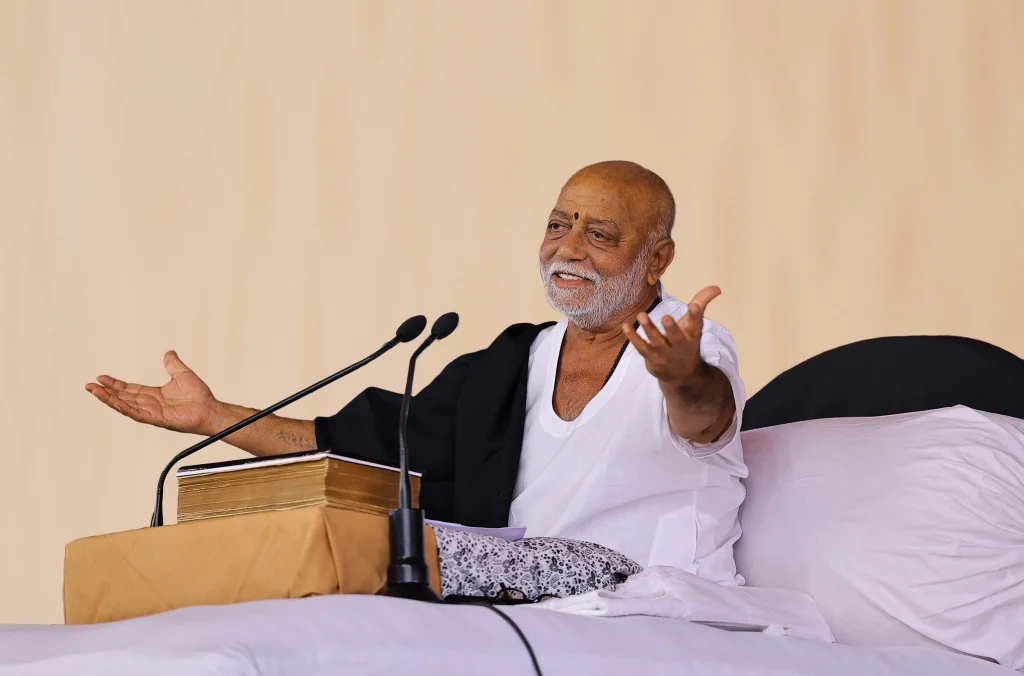
Photo: Wikimedia Commons / CC BY-SA 4.0
Sixty-six years ago, a fourteen-year-old schoolboy sat beneath a banyan tree in the dust of Talgajarda village and started chanting verses from Tulsidas’ Ramcharitmanas to a handful of curious farmers. Today, Morari Bapu has crossed 980 nine-day recitals worldwide. He has spoken on the barren banks of Lake Mansarovar, inside auditoriums in Nairobi and London, and on the grass at Jesus College, Cambridge. He is eighty years old now. He still lives in the same Saurashtra village where he grew up.
Most public spiritual figures build institutions, hierarchy, and titles. Bapu did the opposite. He does not initiate disciples. He does not run ashram networks or charge gate fees. When crowds gather in their tens of thousands under cavernous fabric marquees, he addresses them as “flowers,” not followers. The distinction is deliberate. A flower brings fragrance and asks for nothing; a follower brings expectations and dogma.
His core framework rests on three words: Satya (Truth), Prem (Love), and Karuna (Compassion). Yet before any of this became an international phenomenon, Bapu spent ten quiet years grading student notebooks as a primary school teacher in Mahuva. That classroom discipline never left him.
| Biographical Detail | Information |
|---|---|
| Full Name | Moraridas Prabhudas Hariyani |
| Common Name | Morari Bapu |
| Date of Birth | 2 March 1946 (Maha Shivaratri; civil registry records 25 September 1946) |
| Current Age | 80 years old (as of late 2026) |
| Birthplace | Talgajarda, near Mahuva, Bhavnagar District, Gujarat, India |
| Spiritual Lineage | Margi Sadhu, Vaishnava Nimbarka Sampradaya |
| Height | Approximately 165 cm (5 ft 5 in) widely cited; no biometric disclosure released |
| Parents | Prabhudas Bapu Hariyani & Savitri Ma Hariyani |
| Grandfather & Guru | Tribhovandas Bapu Hariyani |
| Spouse | Narmadaben Hariyani |
| Children | Three daughters (Bhavna, Prasanna, Sobhana) and one son (Santosh) |
| Education | High school in Mahuva; Shahpur Teacher’s Training College in Junagadh |
| Early Career | Primary school educator at Vinayan Mandir, Mahuva (1966–mid 1970s) |
| Guiding Trio | Satya (Truth), Prem (Love), Karuna (Compassion) |
| Operational Base | Shree Chitrakutdham Trust, Talgajarda, Gujarat |
Early Roots in Talgajarda and the Walks with Tribhovandas Bapu
Talgajarda sits near the Gulf of Khambhat in Saurashtra. When Morari Bapu was born there in 1946, the region moved to agrarian rhythms. In village homes, time was marked by moon phases and festival nights. His family celebrated his birth on Maha Shivaratri, which fell on 2 March that year. Later, when British-era civil and school documents were logged, 25 September 1946 entered the records. Both dates remain part of his documented history.
He grew up in a home of six brothers and two sisters. Money was tight, but spiritual literacy was immense. His grandfather, Tribhovandas Bapu Hariyani, belonged to the Margi Sadhu lineage of the Nimbarka tradition. He saw something sharp in the boy’s memory.
Every morning, young Morari walked five kilometers from Talgajarda to his school in Mahuva. Tribhovandas walked beside him. The grandfather’s rule was simple: memorize three chaupais from Tulsidas on the way there, and recite them on the way back. If the boy stumbled, they repeated the stanza until the meter settled into his lungs. By sixteen, Bapu knew entire cantos by heart.
His grandmother Amrit Ma shaped his temperament. She disliked harsh words and taught him to avoid judging neighbors. In 1960, when Bapu set up a small wooden seat under a village banyan tree to tell the story of Ram over nine mornings, he had no grand plans. A few village elders came to listen. He was fourteen.
Ten Years at the Blackboard in Mahuva
Spiritual storytelling did not replace formal training. Bapu finished secondary school in Mahuva, traveled to Junagadh, and enrolled at the Shahpur Teacher’s Training College. He earned his basic teaching credentials and returned home.
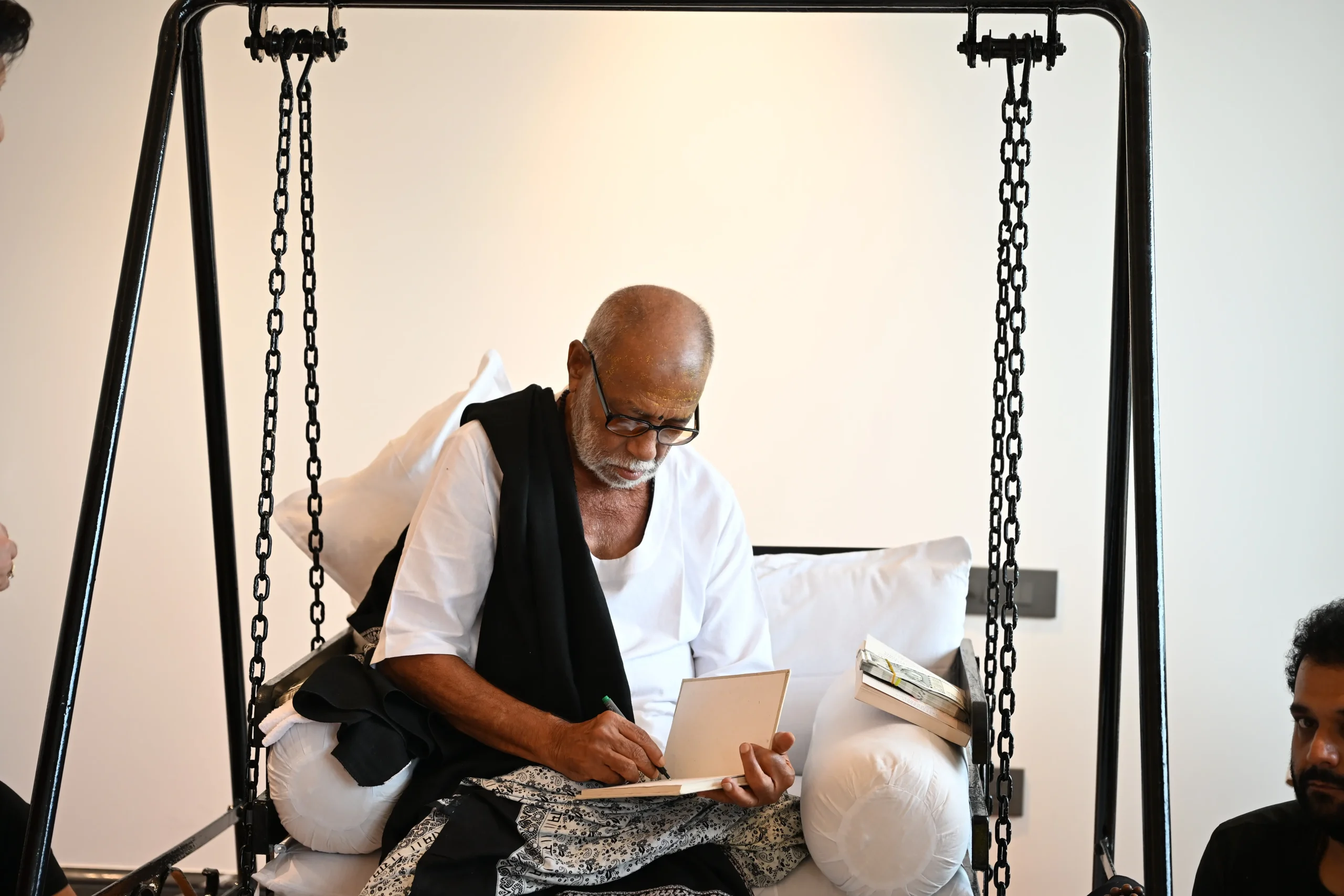
In 1966, he took a post as a primary school teacher at Vinayan Mandir in Mahuva. He stayed ten years.
He taught Gujarati, basic mathematics, and history to young children. He refused to charge struggling families for private tutoring after hours. When classes ended in the afternoon, he would wash up, pack his black shawl, and board state-transport buses to nearby villages that had asked him to speak at local temples. By Monday morning, he was back in the classroom chalk in hand.
By the mid-1970s, invitations were pouring in from across Gujarat and Mumbai. Managing two lives became impossible. He chose the Vyaspeeth, stepped down from government teaching, and committed himself to the Ramcharitmanas full-time. He set one non-negotiable rule that still stands: nobody pays an entrance fee, nobody buys VIP access, and no corporate sponsor gets banner space on the stage.
How a Nine-Day Katha Actually Works
A Morari Bapu katha is not an academic lecture, nor is it a theatrical performance. It runs for nine straight days, beginning on a Saturday and ending the next Sunday. Sessions start early, usually 9:30 AM, and run roughly three to four hours without a break.
Bapu does not open the book on page one and read through to the end. Instead, he selects a single two-line chaupai before the series begins. That couplet becomes the axis for thirty hours of speaking. He pulls threads from it. He will dissect a single Awadhi verb, jump to a couplet by Kabir or Mirabai, quote an Urdu sher by Mirza Ghalib, reference Socrates or Leo Tolstoy, and then pivot into a dry, observational joke about contemporary family squabbles.
Much like how Sadhguru’s spiritual foundation tackles human consciousness through experiential logic, Morari Bapu uses ancient narrative poetry as an entry point for everyday psychology. He frequently tells his listeners to stop obsessing over ritual purity if their hearts harbor irsha (envy) or ninda (gossip). The broadcasts reach millions via Aastha TV and YouTube, but the live atmosphere remains rooted in rustic storytelling.
Taking the Chaupai to Cambridge, Kailash, and the UN
Over sixty-four years of travel, Morari Bapu has set up his Vyaspeeth in staggering settings. In 2001, he took pilgrims to the high-altitude terrain of Mount Kailash and Lake Mansarovar in Tibet. He has spoken inside the United Nations headquarters in New York, at the Vatican in Rome, and across sports stadiums in Nairobi, London, and Toronto.
One of his most publicized international stops happened on 15 August 2023. Bapu was delivering his 927th Ram Katha at Jesus College, University of Cambridge, in the United Kingdom. Midday, then-British Prime Minister Rishi Sunak arrived on the campus and sat among the crowd. When invited to the microphone, Sunak began with “Jai Siya Ram” and told the gathering: “Bapu, I am here today not as a Prime Minister, but as a Hindu.”
Sunak spoke about keeping a small golden Ganesha on his desk at 10 Downing Street and drawing moral courage from the Ramayana when making government decisions. The moment captured global headlines, illustrating how an eighty-year-old storyteller from rural Gujarat could command quiet attention in the academic heart of England.
Between long-haul flights, Bapu has organized massive cultural rail journeys, including the Bharat Swastik Yatra, carrying thousands of travelers on specially chartered trains from Kanyakumari all the way to Kedarnath.
Ayodhya, Red-Light Districts, and Practical Relief
Morari Bapu’s definition of compassion has occasionally enraged conservative religious bodies. He has repeatedly insisted that scripture is useless if it excludes the vulnerable.
In December 2018, Bapu invited 200 commercial sex workers from red-light areas in Mumbai (Kamathipura), Kolkata, Surat, and Lucknow to attend his Ram Katha in Ayodhya. Several local priests and conservative groups protested loudly, calling it a desecration of the sacred city. Bapu did not back down. He cited instances from Tulsidas where marginalized women were offered respect, and spoke publicly about societal hypocrisy that uses women at night while despising them by day.
He backed his words with action. Disciples and trusts mobilized several crore rupees, channelled into non-governmental organizations to fund healthcare, vocational training, and scholarships for the children of sex workers. Later, he hosted and blessed weddings of rehabilitated women at his Talgajarda ashram.
His disaster relief work follows the same direct pattern, echoing the social commitments seen in Kiran Mazumdar-Shaw’s philanthropic initiatives in public health. When catastrophic floods struck Uttarakhand or earthquakes flattened towns in Kutch, the Shree Chitrakutdham Trust dispatched emergency food supplies, medical camps, and direct cash assistance to affected families. When the suspension bridge collapsed in Morbi in 2022, and during subsequent rail and road tragedies, Bapu announced immediate relief funds for the families of the deceased.
He also runs the annual Asmita Parva festival in Talgajarda. Every year, Gujarati poets, playwrights, classical musicians, and critical thinkers gather in his village for four days of uncommercialized dialogue.
Personal Life, Ancestral Home, and Physical Presence
Despite his global reach, Morari Bapu has never relocated. He lives in Talgajarda with his family. He has been married to Narmadaben Hariyani for over fifty years. They raised three daughters—Bhavna, Prasanna, and Sobhana—and a son, Santosh. He wakes before daybreak, walks village dirt roads, and spends hours reading in quiet seclusion.
His public appearance has remained completely unchanged for half a century: an unstitched white dhoti, a white cotton kurta, and a coarse black shawl draped over his left shoulder. Popular biographical accounts list his height at approximately 165 cm (5 feet 5 inches), though his trust has never issued formal biometric disclosures. He treats physical statistics with indifference.
Similar to the personal discipline highlighted in Gaur Gopal Das’s inspiring life journey and Swami Mukundananda’s biographical profile, Morari Bapu’s enduring authority rests on simplicity. He takes no personal fees, keeps no private wealth, and directs all organizational resources through audited charitable trusts.
Morari Bapu Social Media Presence & Verified Accounts
Morari Bapu does not manage individual personal accounts on social media platforms. All official live broadcasts, upcoming katha schedules, book releases, and statements are handled exclusively by the authorized trustees of Shree Chitrakutdham Trust. To avoid counterfeit pages and unofficial accounts, consult these verified destinations:
| Platform | Authorized Handle / Title | Direct Verified Link |
|---|---|---|
| Official Website | Shree Chitrakutdham Trust (Talgajarda) | Visit chitrakutdhamtalgajarda.org |
| X (Twitter) | @MorariBapu_ | Follow @MorariBapu_ on X |
| @chitrakutdhamtalgajarda | Follow @chitrakutdhamtalgajarda on Instagram | |
| Chitrakutdham Talgajarda Morari Bapu | Visit Official Facebook Page | |
| YouTube | Chitrakutdham Talgajarda Official | Subscribe on YouTube |
Frequently Asked Questions About Morari Bapu
Question: How old is Morari Bapu in 2026?
Answer: Morari Bapu is 80 years old as of late 2026. His birth date is celebrated on Maha Shivaratri (2 March 1946) according to traditional Hindu records, while civil documents record 25 September 1946.
Question: What is Morari Bapu’s verified height?
Answer: Morari Bapu stands approximately 165 cm (5 feet 5 inches) tall according to popular biographical records. Official biometric measurements have never been released by his trust, which discourages focus on physical attributes.
Question: Where was Morari Bapu born and where does he currently live?
Answer: He was born in Talgajarda village near Mahuva in the Bhavnagar district of Gujarat, India. Despite worldwide recognition, he still resides primarily in Talgajarda, where his ashram and trust headquarters are located.
Question: What was Morari Bapu’s career before becoming a full-time spiritual narrator?
Answer: After completing teacher training at Shahpur Teacher’s Training College in Junagadh, Morari Bapu worked as a primary school teacher at Vinayan Mandir in Mahuva for approximately ten years before committing full-time to Ram Katha.
Question: How many Ram Kathas has Morari Bapu conducted?
Answer: Morari Bapu has conducted more than 980 nine-day Ram Kathas globally over the course of sixty-four years, having started under a village banyan tree at age fourteen in 1960.
Question: Who was Morari Bapu’s spiritual teacher?
Answer: His paternal grandfather, Tribhovandas Bapu Hariyani, served as his spiritual mentor and guru, teaching him the verses and inner philosophy of Tulsidas’s Ramcharitmanas during their daily walks to school.
Question: Why does Morari Bapu call his listeners “flowers”?
Answer: Morari Bapu rejects the idea of creating a formal cult or hierarchy of followers. He regards every listener as a pure “flower” (Phool) that brings beauty, fragrance, and receptivity to the spiritual gathering.