Marc Benioff Biography: Age, Height, Wife, Salesforce Empire & Verified Accounts
Comprehensive biography of Salesforce co-founder and CEO Marc Benioff: from Atari teenage coder to cloud pioneer, 6’5″ height, Time magazine, and verified accounts.
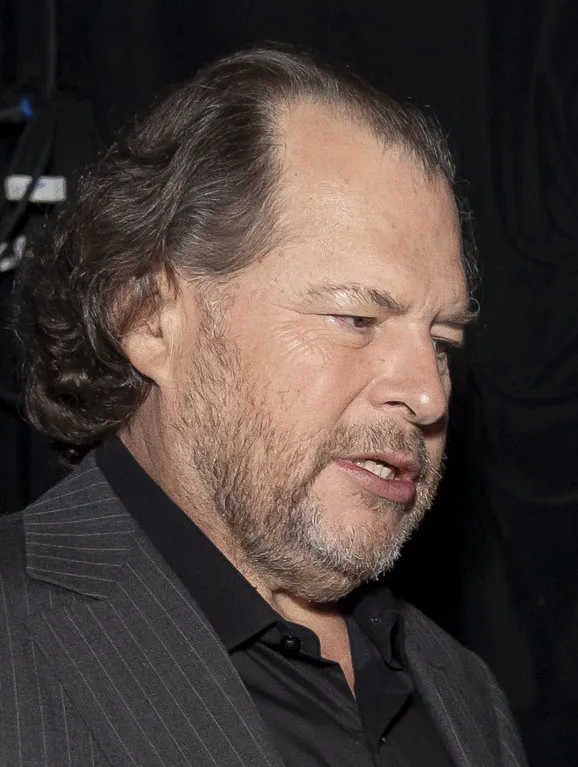
Photo: DHSgov / Wikimedia Commons (Public domain)
In March 1999, four guys crammed card tables into a rented flat at 1449 Montgomery Street on Telegraph Hill. Outside, San Francisco fog rolled past the window. Inside, empty coffee cups piled up next to computer monitors. Enterprise software in those days was a bureaucratic nightmare. You bought pallets of CD-ROMs in shrink-wrapped cardboard, handed millions of dollars to Siebel or SAP, and prayed an army of IT consultants could make it work eighteen months later. Marc Benioff thought the whole racket was insane.
He was thirty-four. He had already pocketed millions from Oracle, drove luxury sports cars, and walked away from a corporate vice presidency because he was bored out of his mind. His pitch was simple enough to sound stupid: what if business software ran inside a standard web browser, cost fifty bucks a month, and required zero hardware? Industry analysts called it a toy. Competitors laughed out loud. Nobody is laughing now.
Quick Facts: Marc Benioff at a Glance
Verified dates, physical measurements, and career records pulled directly from public corporate filings and historical archives:
| Full Legal Name | Marc Russell Benioff |
|---|---|
| Date of Birth | September 25, 1964 |
| Current Age | 62 years old (as of November 2026) |
| Birthplace | San Francisco, California, United States |
| Verified Height | 6 ft 5 in (196 cm) |
| Spouse | Lynne Krilich (married 2006) |
| Children | Two children |
| High School | Burlingame High School (Class of 1982) |
| University Degree | University of Southern California (USC), B.S. in Business Administration (1986) |
| Current Roles | Chair, Chief Executive Officer, and Co-Founder of Salesforce; Co-Owner of Time Magazine |
| Notable Books | Behind the Cloud (2009), Trailblazer (2019), Compassionate Capitalism (2004) |
| Signature Philanthropic Model | 1-1-1 Framework (1% Equity, 1% Product, 1% Employee Volunteer Hours); Pledge 1% |
| Personal Net Worth | Not publicly verified; private wealth fluctuates with Salesforce equity and Time Ventures assets |
Atari Cartridges and Assembly Code: The Teenage Hustle
Benioff grew up in Hillsborough, down the peninsula from San Francisco. His family had roots in city politics. His maternal grandfather, Marvin Lewis, was a trial lawyer and San Francisco supervisor who spent the 1950s fighting stubborn civic bureaucrats to build the Bay Area Rapid Transit (BART) rail system. Lewis took his grandson to public hearings and courtroom arguments. The boy learned early on that large systems do not build themselves; somebody has to drag them into existence.
Computers took over his teens. At fourteen, wandering through local electronics shops, he taught himself how to code. His first commercial application was an instructional program called How to Juggle. He sold it for $75. It was pocket change, but it hooked him.
By fifteen, he launched Liberty Software out of his bedroom. He wrote 8-bit games for the Atari 800 computer, titles like Flapper and King Arthur’s Heir. Royalty cheques arrived in the mailbox: about $1,500 a month. By the time he walked across the stage at Burlingame High School in 1982, his video games had earned enough cash to pay his entire undergraduate tuition at the University of Southern California.
He enrolled at USC’s Marshall School of Business. During the summer of 1984, he landed an internship at Apple Computer in Cupertino. Steve Jobs had just unveiled the Macintosh. Benioff spent forty hours a week typing Motorola 68000 assembly code, fixing low-level system quirks. He loved the Mac, but writing machine code day after day gave him a different realization: hardware was a commodity. The real leverage was customer-facing software.
Thirteen Years Under Larry Ellison at Oracle

When Benioff graduated from USC in 1986, he bypassed engineering departments and took an entry-level customer service desk at Oracle. He had a booming voice, relentless energy, and stood an imposing 6 feet 5 inches tall. In sales calls, he did not just recite feature lists; he diagnosed client friction and closed contracts on the spot. In his first year, Oracle named him Rookie of the Year.
Larry Ellison spotted him quickly. The Oracle chief took Benioff under his wing, showing him how to pick fights with competitors, stage press spectacles, and turn enterprise sales into high-stakes theater. Promotions followed rapidly. At twenty-six, Benioff became the youngest vice president in Oracle history, pulling down a $300,000 salary.
Ten years of corporate combat took a toll. By 1996, Benioff felt completely burned out. He took an extended sabbatical with Ellison’s blessing. He traveled across India, meditated with monks in ashrams, and spent weeks swimming with dolphins in Hawaii. When he returned to California, he told friends he was done selling database licenses. He wanted to build a company that paired commercial aggression with social responsibility.
The Montgomery Street Flat and the Death of the CD-ROM
In early 1999, Benioff teamed up with three technical co-founders: Parker Harris, Dave Moellenhoff, and Frank Dominguez. They holed up in that Telegraph Hill apartment. Their plan targeted customer relationship management (CRM) software, a market dominated by Thomas Siebel’s Siebel Systems.
Benioff went straight for Siebel’s throat. During a major Siebel conference at San Francisco’s Moscone Center, Benioff hired dozens of actors to march outside with picket signs. The signs showed a red slash over a software CD-ROM with the slogan: “The End of Software.” He rented a fleet of fake ambulances branded with the Salesforce logo, claiming to rescue conference attendees from archaic technology. Siebel called the police. Television cameras rushed over. Benioff had engineered millions of dollars in free national publicity before Salesforce even filed its initial public offering.
When the dot-com bubble burst in 2001, hundreds of speculative web startups went belly-up. Salesforce survived. Its monthly subscription model gave cash-strapped corporations real software without upfront capital outlays. Over the next two decades, Benioff built Salesforce into a multi-billion-dollar enterprise cloud standard, launched the AppExchange, erected the 1,070-foot Salesforce Tower, and swallowed major enterprise acquisitions including MuleSoft, Tableau, and Slack.
Enterprise cloud software hit another seismic turn with the arrival of frontier generative artificial intelligence. While Microsoft chief executive Satya Nadella overhauled Office tools and NVIDIA co-founder Jensen Huang supplied the specialized processors driving model clusters, Benioff pivoted his engineering base toward Agentforce in late 2024, deploying autonomous software agents to handle routine enterprise support workflows.
The 1-1-1 Philanthropy Blueprint and Civic Showdowns
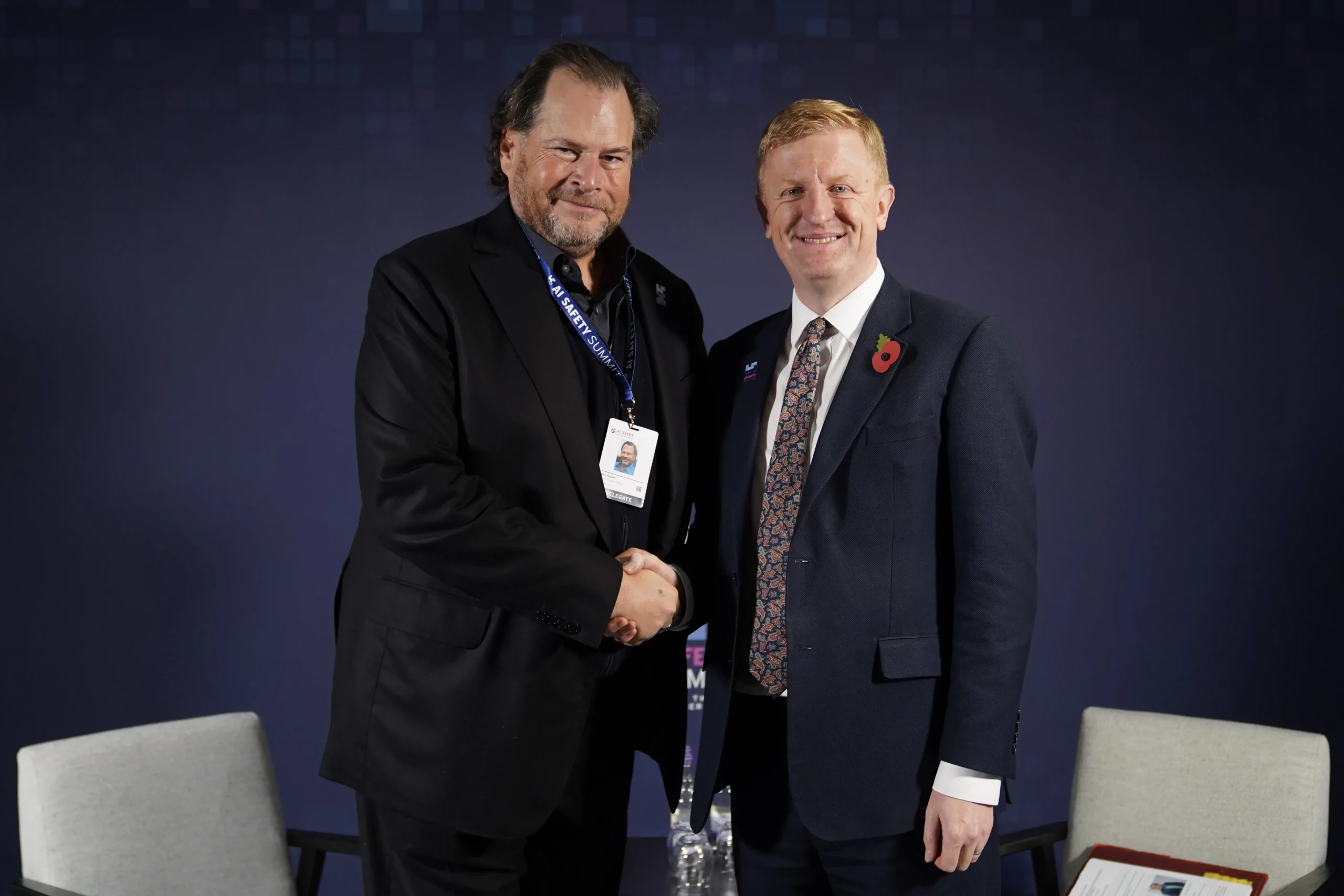
When Benioff founded Salesforce in 1999, he wrote three percentages into the company charter: 1% of equity, 1% of product, and 1% of employee working hours set aside for non-profit causes. In the late 1990s, Silicon Valley treated corporate philanthropy as an afterthought for retirees. Benioff made it mandatory from day one. That framework eventually spun out into Pledge 1%, now adopted by thousands of tech companies worldwide, echoing the company-building philosophy of veteran tech figures like venture capitalist Vinod Khosla as well as frontier AI developers led by OpenAI chief Sam Altman.
Together with his wife Lynne Benioff, he has poured hundreds of millions into public health. The couple donated over $375 million to UCSF Children’s Hospitals in San Francisco and Oakland. They put $88 million into the Benioff Ocean Science Initiative at UC Santa Barbara and financed the launch of 1t.org to plant a trillion trees globally.
He never shied away from political brawls. In 2015, when Indiana passed a religious freedom bill allowing businesses to turn away LGBTQ customers, Benioff threatened to halt all Salesforce travel and investment in the state until lawmakers rewrote the statute. In San Francisco, he broke ranks with other tech executives to fund Proposition C, a tax on gross business receipts to finance homeless shelters and mental healthcare.
Time Magazine, Hawaii, and Personal Life
In September 2018, Marc and Lynne Benioff bought Time magazine for $190 million in cash. Media critics warned that a tech billionaire would meddle in news coverage. Benioff stepped back from day-to-day operations, leaving editorial decisions entirely to the magazine’s journalists.
Benioff married Lynne Krilich in 2006 on the Big Island of Hawaii. They have two children. Over the years, the family spent increasing time in Hawaii, eventually buying land in Waimea. When local residents voiced worries over rising land prices, Benioff donated roughly 440 acres of his parcels to the Hawaii Island Community Development Corporation for affordable local housing and gave $150 million to regional healthcare networks.
Financial indices often throw out multibillion-dollar estimates of his personal fortune based on daily swings in Salesforce stock. SilentRend does not publish unverified numbers. While Benioff’s substantial equity in Salesforce (CRM) and private holdings through Time Ventures are matter of public record, his private net worth is not an audited public disclosure.
Marc Benioff Social Media Presence & Verified Accounts
Direct verified communication endpoints, official executive pages, and social channels for Marc Benioff:
| Platform | Account / Handle | Verified Official Link |
|---|---|---|
| Official Website | Salesforce Executive Leadership | salesforce.com/company/leadership |
| X (Twitter) | @Benioff | x.com/Benioff |
| @benioff | instagram.com/benioff | |
| Marc Benioff | linkedin.com/in/marcbenioff | |
| YouTube | Salesforce Official | youtube.com/@salesforce |
Frequently Asked Questions About Marc Benioff
Question: Exactly how tall is Marc Benioff?
Answer: Marc Benioff is 6 feet 5 inches tall (196 cm). His physical height has been a recognizable trademark throughout his business career, frequently noted when he addresses massive crowds at Dreamforce conferences or shares stages at global tech summits.
Question: How old is Marc Benioff right now?
Answer: Marc Benioff was born on September 25, 1964. As of November 2026, he is 62 years old.
Question: Who is Marc Benioff’s wife and when did they marry?
Answer: Marc Benioff is married to Lynne Krilich (Lynne Benioff). They married in 2006 in Hawaii and have two children together.
Question: Where did Marc Benioff go to college?
Answer: He attended the University of Southern California (USC), graduating from the Marshall School of Business with a Bachelor of Science in Business Administration in 1986. He serves on the USC Board of Trustees.
Question: What was Liberty Software?
Answer: Liberty Software was the teenage software enterprise Marc Benioff founded at age fifteen in 1979. He programmed video games such as Flapper and King Arthur’s Heir for the Atari 800 computer, earning royalties that paid his undergraduate college tuition.
Question: What is Marc Benioff’s 1-1-1 model?
Answer: It is an integrated corporate philanthropy framework created at Salesforce’s launch in 1999. The company contributes 1% of its equity, 1% of its product, and 1% of employee working hours to charitable organizations. The model inspired the global Pledge 1% movement.
Question: What is Marc Benioff’s verified net worth?
Answer: Marc Benioff’s exact private net worth is not publicly verified. While media outlets calculate wealth estimates from his Salesforce shares and Time Ventures portfolio, audited statements of his private holdings are not filed in public regulatory registries.