Jagadguru Rambhadracharya Biography: Age, Blindness, Sanskrit Epics, Jnanpith Award, and Tulsi Peeth
Detailed biography of Jagadguru Rambhadracharya: his childhood in Jaunpur, loss of sight, Sanskrit scholarship, Chitrakoot university, and 58th Jnanpith Award.
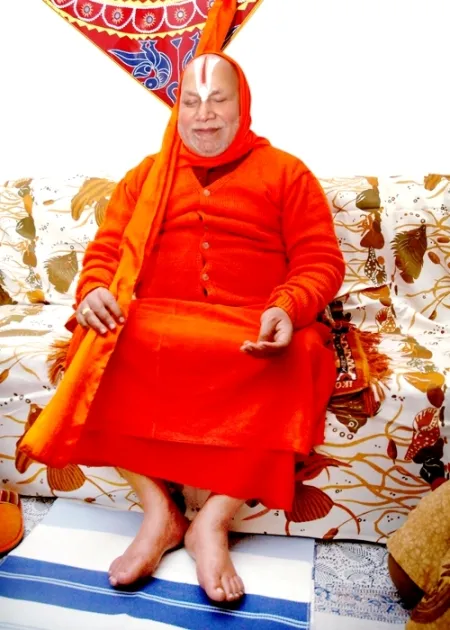
Photo: Shri Tulsi Peeth Seva Nyas / Wikimedia Commons (CC BY 3.0)
Giridhar Mishra was sixty days old when trachoma took his eyes. A village practitioner in Jaunpur applied ground myrobalan paste to soothe the blisters, which caused internal hemorrhaging and destroyed the infant’s retinas permanently. He never learned Braille. He never used a slate.
Decades later, known across India as Jagadguru Ramanandacharya Swami Rambhadracharya, he dictates Sanskrit epics in forty classical meters strictly from memory. His library contains more than 240 published volumes spanning philosophy, grammar, and poetics. In 1988, the Ramanandi order elevated him to one of its four hereditary Jagadguru seats. By 2024, the Jnanpith selection board named him a joint winner of India’s 58th Jnanpith Award alongside lyricist Gulzar.
Now 76 years old, he directs Tulsi Peeth in Chitrakoot and oversees an accredited university built specifically for students with disabilities.
| Full Birth Name | Giridhar Mishra |
|---|---|
| Monastic Name & Title | Jagadguru Ramanandacharya Swami Rambhadracharya |
| Date of Birth | January 14, 1950 (Makar Sankranti) |
| Age (in 2026) | 76 years |
| Birthplace | Shandikhurd village, Jaunpur district, Uttar Pradesh, India |
| Height | 5 ft 5 in (165 cm) |
| Parents | Pandit Rajdev Mishra & Shrimati Shachidevi Mishra |
| Marital Status | Unmarried (Ascetic Sannyasi) |
| Alma Mater | Sampurnanand Sanskrit University, Varanasi |
| Languages | 22 languages (including Sanskrit, Hindi, Awadhi, Maithili) |
| Institutions Founded | Tulsi Peeth (1987), Jagadguru Rambhadracharya Divyang University (2001) |
| Major Honors | Padma Vibhushan (2015), 58th Jnanpith Award (2024), Sahitya Akademi Award (2005) |
Early Childhood, Loss of Sight, and Auditory Recall
Shandikhurd in eastern Uttar Pradesh had few roads in 1950 and no eye hospital. When trachoma set in on March 24, 1950, Giridhar’s family turned to a local elder who treated ocular swellings with herbal extracts. The astringent mixture triggered bleeding that scarred his corneas beyond repair. Hospital visits to King George’s Medical College in Lucknow and private consultations in Sitapur and Bombay yielded no cure.
Unable to see printed characters, Giridhar’s education became entirely acoustic.
His grandfather, Pandit Suryabali Mishra, began reciting Hindu scriptures aloud during afternoon breaks while Giridhar sat beside him. By age five, the boy had retained all 700 verses of the Bhagavad Gita verbatim, complete with metered inflections. At eight, he had committed the entire Ramcharitmanas to memory, demonstrating a rare capability known in Indian classical traditions as spontaneous recall.
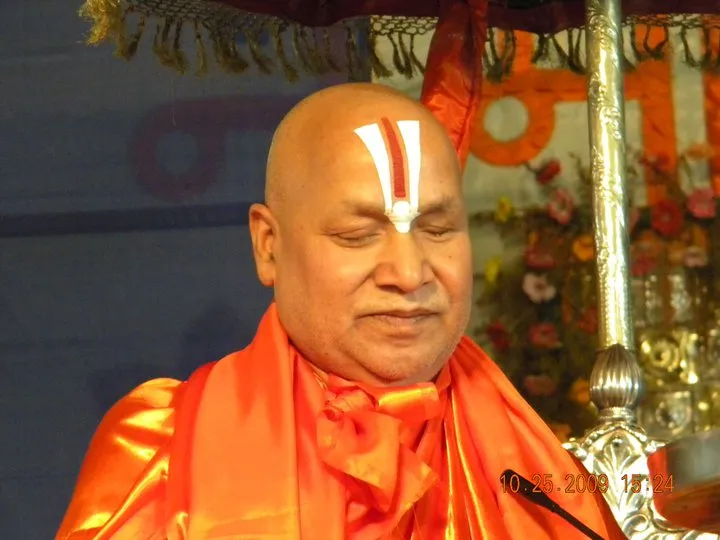
Varanasi Academics and Paninian Grammar
Giridhar delayed formal schooling until July 1967. Entering Adarsh Gaurav Sanskrit Mahavidyalaya at seventeen, he soon transferred to Sampurnanand Sanskrit University in Varanasi. Scribes wrote his examination answers under proctored university guidelines.
He ranked first in every class, taking gold medals across his intermediate and postgraduate terms. In 1976, he completed his Acharya degree in Navya Vyakarana, the intricate system of modern Sanskrit grammar established by Panini and Patanjali. Five years later, in 1981, he finished his doctoral research (Vidyavaridhi) on the Adhyatma Ramayana, eventually earning a Doctor of Letters (Vachaspati) in 1997.
His facility with classical meters allowed him to compose spontaneous verse without pauses or revisions. Scholars in Varanasi designated him an Ashukavi.
Monastic Ordination and the Ramanandacharya Seat
In November 1983, Giridhar received Virakt Diksha (formal ascetic vows) from Pandit Ramcharandas Maharaj at the banks of the Sarayu. He shed his family identity and assumed the ascetic title Rambhadradas.
On June 24, 1988, the Kashi Vidwat Parishad chose him as Jagadguru Ramanandacharya for the Tulsi Peeth seat in Chitrakoot. The nomination drew universal support during the 1989 Prayagraj Kumbh Mela, where leaders of the Ramanandi Akharas formally ratified his status. In August 1995, the Digambar Akhara in Ayodhya presided over his public consecration.
The appointment placed him at the head of the Ramananda Sampradaya, the Vaishnava tradition founded in the fourteenth century. Rather than administrative monasticism, he dedicated his tenure to writing scholarly treatises, producing comprehensive verse commentaries on the Upanishads, Brahma Sutras, and Bhagavad Gita.
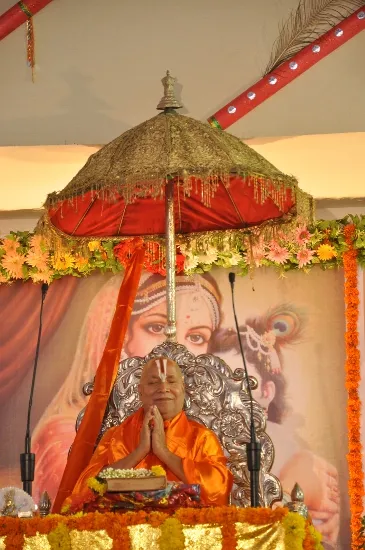
Chitrakoot Institutions and University for Disabled Students
In 1987, Rambhadracharya established Tulsi Peeth along the Mandakini river in Chitrakoot, constructing ashram quarters where Tulsidas was believed to have composed lines of the Ramcharitmanas. The trust operates charitable eye clinics, publishing presses, and scriptural libraries.
Fourteen years later, in September 2001, he founded the Jagadguru Rambhadracharya Handicapped University in Chitrakoot (later renamed Jagadguru Rambhadracharya Divyang State University). Serving as permanent chancellor, he shaped its charter so that only students with physical, visual, auditory, or intellectual disabilities could enroll. The campus features custom tactile walking tracks, auditory signals, adapted computer laboratories, and tuition-free degree programs in humanities, fine arts, and software design.
His institution-building in central India parallels large-scale educational programs created by contemporary figures like Sadhguru in Tamil Nadu and Sri Sri Ravi Shankar through Art of Living learning foundations.
Literary Corpus, Epic Poetry, and the 58th Jnanpith Award
Rambhadracharya writes in Sanskrit, Hindi, Awadhi, and Maithili. His bibliography exceeds 240 works.
Among his major compositions is Śrībhārgavarāghavīyam, a 2002 Sanskrit epic consisting of 2,121 verses divided into 21 cantos. The work earned him the Sahitya Akademi Award for Sanskrit in 2005. His second epic, Arundhatī, details the life of the Vedic sage Vasishtha’s consort across 15 cantos, while Aṣṭāvakra recounts the dialogues of the Vedic philosopher who lived with physical deformities.
In February 2024, the Bharatiya Jnanpith committee selected Rambhadracharya for the 58th Jnanpith Award alongside Urdu lyricist Gulzar. It was the second time in Jnanpith history that Sanskrit was honored and the first time the accolade went to a practicing Hindu monk.
His traditional storytelling also shares common roots with Morari Bapu, who has held hundreds of nine-day Ram Kathas globally, while modern urban exponents like Gaur Gopal Das interpret scriptural values for corporate and university settings.
Deposition in the Ayodhya Title Suit
In July 2003, the Lucknow Bench of the Allahabad High Court summoned Rambhadracharya as an expert witness on ancient scriptures (OPW 16) during the Ayodhya Ram Janmabhoomi title dispute. He appeared without notes.
Under cross-examination, he recited 441 lines from memory, drawing on the Atharvaveda, Yajurveda, Valmiki Ramayana, and the Ayodhya Mahatmya from the Skanda Purana. He cited eight verses from Tulsidas’s Doha Shataka describing the demolition of a temple in 1528 CE, and pointed to geographical references in ancient Puranas that fixed the sacred boundary lines relative to the Sarayu river. The High Court judges documented his deposition across pages of their 2010 judgment, which subsequently formed part of the historical record upheld by the Supreme Court of India in November 2019.
Jagadguru Rambhadracharya Social Media Presence & Verified Accounts
| Platform | Account / Channel Name | Verified Web Link |
|---|---|---|
| YouTube | @SwamiRambhadracharayaji_ | Visit YouTube Channel |
| Jagadguru Rambhadracharya Official | Visit Facebook Page | |
| @swami_rambhadracharaya_ji | Visit Instagram Profile | |
| Institutional Portal | JRDSU University Chitrakoot | Visit JRDSU Official Site |
Frequently Asked Questions
Question: What is Jagadguru Rambhadracharya’s height?
Answer: Jagadguru Rambhadracharya stands at approximately 5 feet 5 inches (165 cm).
Question: What is Jagadguru Rambhadracharya’s age in 2026?
Answer: Born on January 14, 1950, Jagadguru Rambhadracharya is 76 years old as of 2026.
Question: How did Jagadguru Rambhadracharya lose his sight?
Answer: He lost his physical eyesight at two months of age in March 1950 after a severe trachoma infection was treated with an abrasive herbal remedy in his village, causing fatal bleeding in the ocular tissue.
Question: Did Jagadguru Rambhadracharya use Braille to learn?
Answer: No. He has never read or written using Braille. He acquired his education through listening and composes all his literary works by dictating verses to scribes.
Question: For which work did Jagadguru Rambhadracharya receive the Jnanpith Award?
Answer: He received the 58th Jnanpith Award (for 2023, announced in February 2024) for his lifetime contribution to Sanskrit literature, which includes epics such as Śrībhārgavarāghavīyam and extensive commentaries on the Prasthanatrayi.
Question: What is Jagadguru Rambhadracharya’s net worth?
Answer: As an ascetic Ramanandi monk who took vows of complete renunciation (Sannyasa), Jagadguru Rambhadracharya holds no personal commercial assets, corporate investments, or private wealth. All organizational institutions belong to public registered charitable trusts.